
The UK's cryptoasset regulatory landscape is entering a defining phase. With the Financial Conduct Authority (FCA) set to open the cryptoasset application gateway on 30 September 2026, firms operating in,or planning to enter,the UK cryptoasset market face a critical window to secure authorisation ahead of the new regime's commencement on 25 October 2027. Preparing for the UK Cryptoasset Application Gateway: FCA Authorisation Timeline and Readiness Checklist for 2026 is no longer optional. it is a strategic imperative for compliance officers, risk managers, and advisory professionals who value substance over speculation. Explore more in our Consulting Insights section.
On 8 January 2026, the FCA provided firms with crucial clarity on the authorisation process, establishing concrete timelines and expectations that demand immediate attention. [1] [6] The approximately five-month submission window,closing on 28 February 2027,creates a first-come, first-served dynamic where applications will be assessed strictly in the order they are received. [2] This framework rewards early preparation and penalises delay with potentially severe commercial consequences.
This comprehensive guide provides a structured methodology for navigating the authorisation gateway, tailored specifically for professionals who demand evidence-based guidance grounded in UK regulatory reality.
Understanding the FCA Cryptoasset Authorisation Gateway Timeline
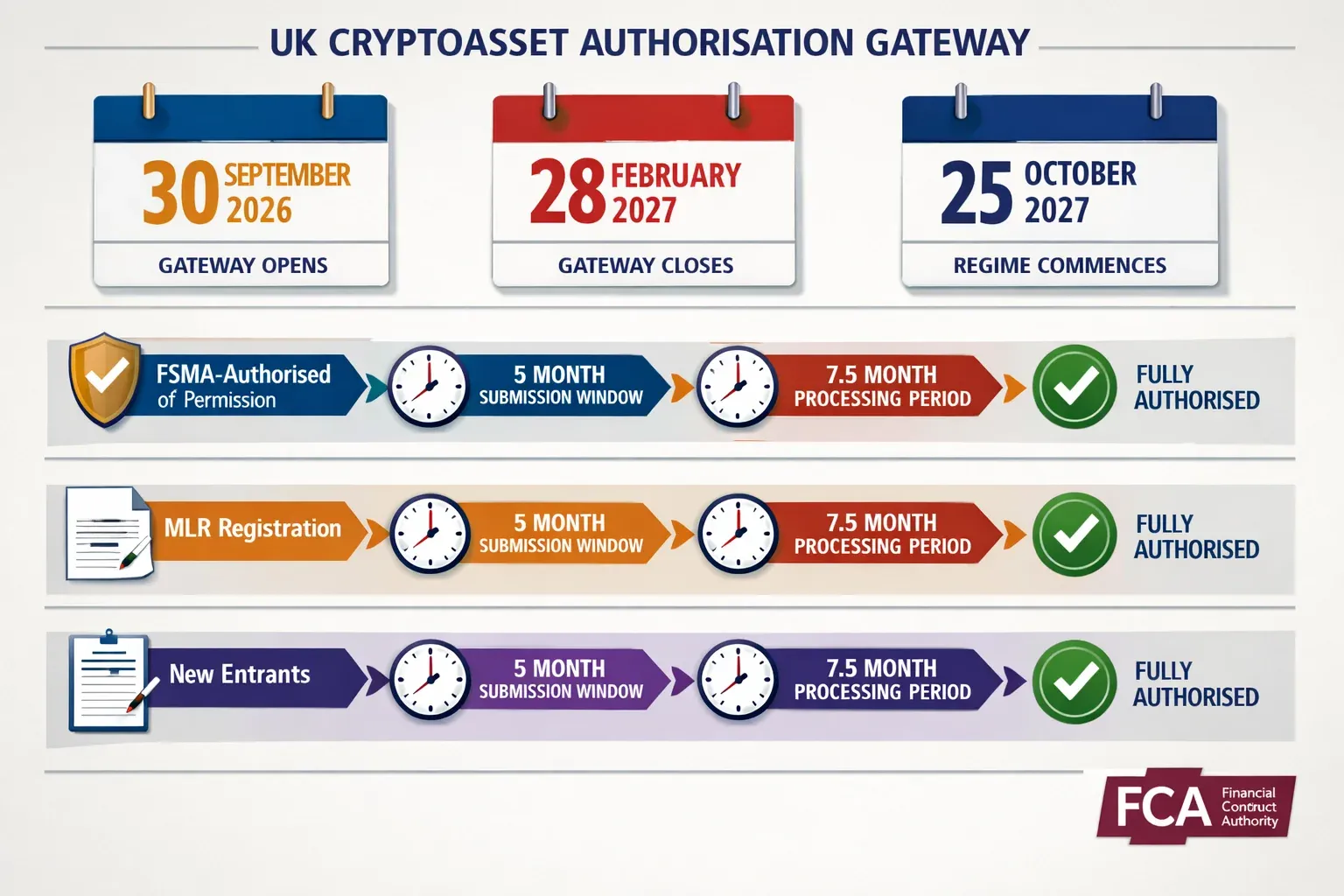
Critical Dates for Preparing for the UK Cryptoasset Application Gateway
The FCA has established a carefully structured timeline that creates distinct strategic windows and consequences for firms at different stages of readiness. [1] [3]
July 2026: PASS Launch and Application Forms Release The Pre-Application Support Service (PASS) is expected to open in July 2026, coinciding with the release of new application forms. [2] This represents the first opportunity for firms to engage directly with the FCA regarding their specific circumstances and to understand the granular detail required for successful applications. PASS sessions are strongly encouraged but not mandatory, and may occur across multiple meetings depending on complexity. [2]
30 September 2026: Gateway Opens The application gateway officially opens, commencing the five-month submission window. [3] [4] From this date, the FCA begins accepting applications on a strictly first-come, first-served basis, with no prioritisation for firms holding existing FSMA permissions. [2] This creates a clear commercial incentive for early submission.
28 February 2027: Gateway Closes The submission window closes after approximately five months. [3] [4] Applications submitted during this window qualify for "saving period" protection, a critical transitional provision discussed below.
25 October 2027: New Regime Commences The comprehensive cryptoasset regulatory regime goes live. [1] [3] The FCA has approximately 7.5 months between gateway closure and regime commencement to process applications submitted during the window. The regulator expects to determine applications submitted during the gateway period ahead of this date, enabling orderly transition. [1]
The Saving Period: Why Timing Matters
Understanding the saving period is essential for strategic planning around preparing for the UK Cryptoasset Application Gateway: FCA Authorisation Timeline and Readiness Checklist for 2026.
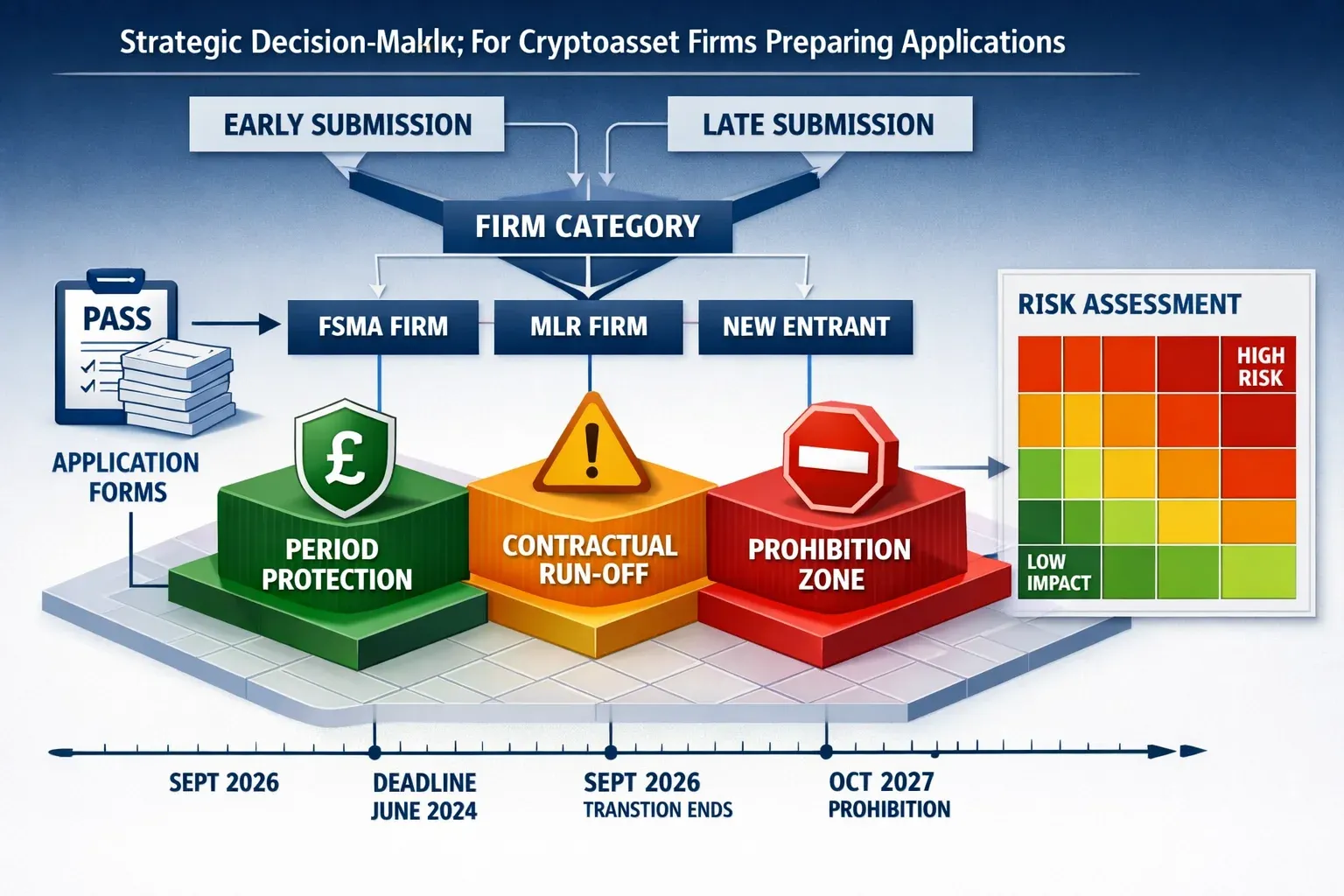
Firms that submit applications during the gateway window (30 September 2026 to 28 February 2027) enter a saving period that provides crucial operational continuity. [1] [2] If an application remains under FCA review when the regime commences on 25 October 2027, the firm can continue serving customers and conducting cryptoasset activities while awaiting determination.
This protection represents a significant competitive advantage. Firms can maintain business continuity, preserve customer relationships, and generate revenue throughout the assessment period without operational disruption.
Contrast this with firms that miss the gateway window:
- Applications submitted after 28 February 2027 but before 25 October 2027: If not determined by commencement, these firms face severe restrictions,they can only operate under a limited contractual run-off regime serving pre-existing customers with no ability to acquire new business. [1]
- Applications submitted only after 25 October 2027: These firms receive no transitional protection whatsoever and are generally prohibited from carrying on regulated cryptoasset activities in the UK until authorisation is granted. [1]
The commercial implications are stark: delayed submission could mean months of being unable to compete for new customers while competitors with saving period protection continue normal operations.
Determining Your Firm Category and Application Type
Preparing for the UK Cryptoasset Application Gateway: FCA Authorisation Timeline and Readiness Checklist for 2026 begins with accurately determining which category your firm falls into, as this dictates your application pathway. [2]
Category 1: FSMA-Authorised Firms Seeking Variation of Permission
If your firm already holds FSMA authorisation for other regulated activities and wishes to add cryptoasset activities, you must apply for a Variation of Permission (VoP). [2]
Key considerations:
- Your existing regulatory infrastructure provides a foundation, but cryptoasset-specific requirements demand additional governance, systems, and controls
- You must demonstrate how cryptoasset activities integrate with existing compliance frameworks
- Senior Management Arrangements, Systems and Controls (SYSC) must be updated to address cryptoasset-specific risks
- Financial resources must be adequate for the expanded scope of activities
Advantage: Existing relationship with the FCA and established regulatory infrastructure may streamline certain aspects of the application.
Challenge: The FCA will scrutinise whether your current governance model can genuinely accommodate cryptoasset risks or requires fundamental restructuring.
Category 2: MLR-Registered Firms Requiring Full FSMA Authorisation
Firms currently registered under the Money Laundering Regulations (MLR) for cryptoasset activities must apply for full FSMA authorisation to continue operations under the new regime. [2]
Key considerations:
- MLR registration is substantially less rigorous than FSMA authorisation,expect a step-change in regulatory expectations
- You must build comprehensive governance structures, potentially including new senior management function (SMF) appointments
- Financial resources requirements under FSMA are more demanding than MLR
- Systems and controls must meet FSMA standards, including detailed policies, procedures, and oversight mechanisms
Advantage: You have operational experience in the UK cryptoasset market and existing customer relationships.
Challenge: The transition from MLR to FSMA represents a significant regulatory uplift that may require substantial investment in compliance infrastructure, personnel, and systems.
Category 3: New Entrants Seeking FSMA Authorisation
Firms not currently authorised or registered in the UK must apply for full FSMA authorisation from inception. [2]
Key considerations:
- You must demonstrate complete readiness across all regulatory dimensions with no existing FCA relationship
- The FCA expects credible, capable leadership teams who understand regulatory application, governance integration, and operational risk management [2]
- Financial resources must be proven, not merely projected
- Systems and controls must be operational or demonstrably ready for implementation
Advantage: You can build compliance infrastructure from the ground up without legacy system constraints.
Challenge: No existing FCA relationship means higher scrutiny and no track record to demonstrate competence.
Comprehensive Readiness Checklist for the FCA Cryptoasset Gateway
This section provides a structured, assessment-led checklist for firms preparing applications. The FCA has indicated that firms must be substantively prepared at the point of application submission, despite some aspects of the detailed rulebook remaining subject to consultation. [1]
📋 Strategic Foundations
✅ Activity Mapping and Scope Definition
- Conduct comprehensive mapping of all current and planned cryptoasset activities against FCA regulatory perimeter definitions
- Identify which activities fall under regulated categories (e.g., operating a cryptoasset trading platform, providing custody, offering advisory services)
- Document activities that may be exempt or outside scope
- Assess cross-border implications if serving customers outside the UK
✅ Firm Category Determination
- Confirm whether your firm is FSMA-authorised, MLR-registered, or a new entrant
- Determine correct application type (VoP vs full authorisation)
- Review existing permissions and assess compatibility with cryptoasset activities
✅ Timeline Strategy Development
- Establish internal target submission date (recommend early in the September 2026–February 2027 window)
- Map backwards from submission date to identify preparation milestones
- Allocate resources for PASS engagement (July 2026 onwards)
- Build contingency time for unexpected regulatory queries or documentation gaps
🏛️ Governance and Senior Management
✅ Senior Management Arrangements
- Identify and appoint individuals to relevant Senior Management Functions (SMFs) with cryptoasset competence
- Ensure SMF holders demonstrate understanding of cryptoasset risks, market dynamics, and regulatory requirements
- Document clear responsibilities and accountability frameworks
- Prepare statements of responsibilities that reflect cryptoasset-specific duties
✅ Board and Committee Structure
- Establish or update board-level oversight of cryptoasset activities
- Create or enhance risk committees with cryptoasset expertise
- Document governance frameworks showing clear escalation pathways
- Demonstrate how cryptoasset risks are integrated into enterprise risk management
✅ Fitness and Propriety
- Conduct thorough fitness and propriety assessments for all SMF holders and certified persons
- Document relevant qualifications, experience, and training in cryptoassets
- Address any regulatory history or conduct issues transparently
- Consider professional credentials such as assessment-led certification from independent standards bodies like TrustCrypto Institute to demonstrate competence
💰 Financial Resources and Capital Adequacy
✅ Capital Requirements Assessment
- Calculate minimum capital requirements based on firm category and activity scope
- Prepare financial projections demonstrating sustainability under various scenarios
- Document sources of capital and evidence of availability
- Establish capital monitoring and reporting procedures
✅ Professional Indemnity Insurance
- Secure appropriate professional indemnity insurance covering cryptoasset activities
- Document coverage limits, exclusions, and claims history
- Ensure policy wording aligns with FCA expectations
✅ Wind-Down Planning
- Develop credible wind-down plans showing how the firm would cease operations in an orderly manner
- Quantify wind-down costs and demonstrate adequate resources
- Document customer protection measures during wind-down scenarios
🔐 Systems, Controls, and Risk Management
✅ Systems and Controls Framework
- Document comprehensive policies and procedures covering all cryptoasset activities
- Establish transaction monitoring and surveillance systems
- Implement cybersecurity controls appropriate to cryptoasset risks (custody, key management, platform security)
- Create incident response and business continuity plans addressing cryptoasset-specific scenarios
✅ AML/CTF and Financial Crime
- Develop robust anti-money laundering and counter-terrorist financing frameworks
- Implement customer due diligence procedures appropriate to cryptoasset risks
- Establish transaction monitoring for suspicious activity
- Document sanctions screening and politically exposed persons (PEP) procedures
- Appoint a qualified Money Laundering Reporting Officer (MLRO)
✅ Operational Resilience
- Conduct operational resilience self-assessments identifying important business services
- Map dependencies on third parties, technology providers, and infrastructure
- Set impact tolerances and test against scenarios
- Document operational resilience governance and testing programmes
✅ Consumer Protection and Conduct
- Develop clear, fair, and not misleading communications and marketing materials
- Establish product governance frameworks
- Implement conflicts of interest management procedures
- Create complaints handling procedures
- Document vulnerable customer protections
📊 Application Documentation Preparation
✅ Application Form Completion
- Await release of new application forms (expected July 2026) [2]
- Assign responsibility for form completion to qualified personnel
- Gather supporting documentation in advance (organisational charts, policies, financial statements)
- Conduct internal quality assurance reviews before submission
✅ Business Plan Development
- Prepare detailed business plan covering strategy, target markets, revenue models, and growth projections
- Demonstrate understanding of market dynamics and competitive positioning
- Include realistic financial forecasts with supporting assumptions
- Address how the firm will maintain compliance as it scales
✅ Supporting Evidence Compilation
- Compile evidence of systems and controls implementation (screenshots, policy documents, audit trails)
- Gather proof of financial resources (bank statements, capital commitments, insurance policies)
- Document senior management expertise (CVs, qualifications, references)
- Prepare organisational charts and governance documentation
🤝 FCA Engagement Strategy
✅ Pre-Application Support Service (PASS)
- Register for PASS when it opens in July 2026 [2]
- Prepare comprehensive briefing materials for initial PASS meeting
- Identify specific questions or areas of uncertainty to discuss
- Allocate senior personnel to PASS sessions (the FCA expects engagement from credible leadership) [2]
- Document FCA feedback and adjust application accordingly
✅ Ongoing Regulatory Monitoring
- Monitor FCA consultations and policy statements for updates to cryptoasset requirements
- Subscribe to FCA alerts and regulatory news services
- Participate in industry consultations to stay informed
- Adjust preparation activities based on evolving regulatory expectations
Strategic Considerations for Preparing for the UK Cryptoasset Application Gateway

Early Submission vs Waiting for Regulatory Clarity
A tension exists between submitting early (to secure queue position and saving period protection) and waiting for complete regulatory clarity as final rules are published.
The case for early submission:
- First-come, first-served processing creates clear advantage [2]
- Saving period protection provides crucial business continuity [1] [2]
- The FCA expects substantive readiness despite ongoing consultations [1]
- Competitive positioning: early authorisation enables market leadership
The case for waiting:
- Final rulebook details may affect application content
- Later applicants can learn from early application experiences
- Additional time allows more thorough preparation
TrustCrypto Institute perspective: The evidence favours early submission for firms with strong fundamentals. The FCA has been clear that it expects firms to be substantively prepared now, and the commercial consequences of delayed submission are severe. Firms should focus on building robust, principles-based compliance frameworks that will withstand regulatory evolution rather than waiting for every detail to crystallise.
Building Credible Cryptoasset Competence
The FCA has explicitly stated it is seeking "credible, capable leadership teams who understand regulatory application, governance integration, and operational risk management." [2] This is not merely about ticking boxes,it reflects the regulator's focus on competence and ethics as foundational to consumer protection.
Demonstrating credible competence:
- Professional qualifications: Consider industry-recognised certifications such as TrustCrypto Institute's Certified Crypto Compliance Advisor (TCCA) or Certified Crypto Compliance Specialist (TCCS) credentials, which provide verified credentials and transparent disclosures of competence
- Continuing professional development: Document ongoing CPD in cryptoasset regulation, technology, and risk management
- Track record: Evidence of successful regulatory engagement, compliance delivery, or cryptoasset operational experience
- Advisory support: Engage qualified professionals with proven FCA application experience
This competence-first approach aligns with the broader principle of raising the baseline for professional standards in the UK cryptoasset sector,a principle that benefits consumers, firms, and the market's long-term credibility. Learn more with our crypto tax calculator.
Resource Allocation and Project Management
Preparing for FCA authorisation is a substantial undertaking requiring dedicated resources, clear accountability, and rigorous project management.
Resource considerations:
- Personnel: Assign a senior project lead with direct board accountability
- External advisors: Engage legal, compliance, and technical specialists with cryptoasset regulatory expertise
- Budget: Allocate sufficient budget for application fees, professional fees, system implementations, and potential delays
- Timeline: Build realistic timelines with contingency for regulatory queries and documentation iterations
Project governance:
- Establish steering committee with senior management representation
- Create detailed project plan with milestones aligned to gateway timeline
- Implement regular progress reporting to board
- Conduct readiness assessments against this checklist at defined intervals
Common Pitfalls and How to Avoid Them
Underestimating the Regulatory Uplift
Many firms, particularly those currently MLR-registered, underestimate the step-change in regulatory expectations under FSMA authorisation. MLR registration focuses primarily on financial crime controls. FSMA authorisation demands comprehensive governance, prudential soundness, conduct standards, and operational resilience.
Mitigation: Conduct an honest gap analysis comparing current state to FSMA requirements early in the preparation process. Budget for substantial infrastructure investment if gaps are significant.
Inadequate Senior Management Engagement
Applications fail when senior management treats authorisation as a compliance exercise delegated to junior personnel. The FCA expects senior leaders to demonstrate genuine understanding and ownership.
Mitigation: Ensure SMF holders are directly involved in application preparation, PASS sessions, and policy development. Invest in senior management training and professional development in cryptoasset regulation.
Weak Financial Projections
Overly optimistic financial projections that lack supporting evidence or fail to address downside scenarios undermine credibility.
Mitigation: Develop conservative, well-evidenced financial models. Stress-test projections against adverse market conditions (relevant given cryptoasset volatility). Demonstrate capital adequacy under multiple scenarios.
Incomplete Systems and Controls Documentation
Describing intended systems and controls without evidence of implementation raises red flags. The FCA expects operational readiness, not aspirational plans.
Mitigation: Implement systems and controls before application submission. Provide evidence of operation (audit logs, transaction monitoring reports, policy attestations). Conduct internal audits to validate effectiveness.
Late Submission Due to Perfectionism
Waiting for perfect readiness can result in late submission, losing queue position and saving period protection.
Mitigation: Adopt a "substantively ready" standard aligned with FCA expectations. [1] Recognise that some regulatory detail will evolve post-submission. Focus on robust fundamentals and principles-based frameworks.
The Role of Professional Standards and Certification
As the UK cryptoasset sector matures under comprehensive regulation, professional accountability and verified credentials become increasingly important differentiators.
For compliance officers, risk managers, and advisors involved in preparing applications, demonstrating competence through assessment-led certification from independent standards bodies provides several advantages:
Regulatory credibility: Professional certifications signal to the FCA that individuals possess verified knowledge of UK crypto regulation, AML/CTF requirements, and compliance frameworks.
Firm readiness: Employing certified professionals demonstrates the firm's commitment to competence and ethics, addressing the FCA's focus on credible, capable teams. [2]
Career development: For professionals, recognised credentials provide clear frameworks for advancement in the growing crypto compliance field.
Consumer confidence: As the sector professionalises, investors and customers increasingly demand advisors with transparent disclosures of qualifications and adherence to published frameworks.
TrustCrypto Institute's certification pathways,including the Certified Crypto Compliance Advisor (TCCA) and Certified Crypto Compliance Specialist (TCCS),provide rigorous assessment of regulatory knowledge, ethical standards, and practical application. These credentials are designed specifically for the UK regulatory environment, grounded in FCA guidance, HMRC rules, and MLR requirements.
For firms preparing gateway applications, investing in team certification represents a strategic commitment to substance over speculation and long-term perspective over short-term compliance box-ticking.
Conclusion: Standards Matter in the Gateway Era
Preparing for the UK Cryptoasset Application Gateway: FCA Authorisation Timeline and Readiness Checklist for 2026 represents more than a regulatory hurdle,it is an opportunity to demonstrate institutional credibility, operational excellence, and genuine commitment to consumer protection.
The timeline is clear and unforgiving: the gateway opens 30 September 2026, closes 28 February 2027, and the regime commences 25 October 2027. [1] [3] Applications will be processed strictly in submission order, with no priority for existing authorised firms. [2] The commercial consequences of delay,loss of saving period protection, contractual run-off restrictions, or outright prohibition,create powerful incentives for early, thorough preparation.
Success requires more than completing forms. The FCA expects substantive readiness: credible leadership with demonstrated cryptoasset competence, robust governance frameworks, adequate financial resources, and operational systems that genuinely protect consumers and manage risks. [1] [2]
Actionable next steps:
- Determine your firm category and application type (VoP vs full authorisation) immediately
- Conduct a comprehensive gap analysis using this readiness checklist to identify preparation priorities
- Allocate dedicated resources and establish senior-level project governance with board accountability
- Register for PASS when it opens in July 2026 and prepare thoroughly for FCA engagement [2]
- Invest in professional competence through training, certification, and advisory support to build credible teams
- Target early submission within the gateway window to secure queue position and saving period protection
- Monitor regulatory developments continuously and adjust preparation activities as guidance evolves
For compliance officers, risk managers, and advisory professionals, this is a defining moment. The firms that approach the gateway with rigour, transparency, and genuine commitment to raising the baseline will not only secure authorisation,they will establish themselves as trusted participants in the UK's regulated cryptoasset future.
The question is not whether to prepare, but whether you are prepared to meet the standard the market,and consumers,increasingly demand.
Related Resources
Explore these helpful tools and guides:
Take the Next Step
Ready to advance your crypto expertise? Explore our professional certification programmes to enhance your credentials.
References
- [1] Uk Cryptoasset Regulation Action Points For 2026 2027 - https://www.sidley.com/en/insights/newsupdates/2026/01/uk-cryptoasset-regulation-action-points-for-2026-2027
- [2] The Fcas New Cryptoasset Authorisation Gateway Key Timelines Expectations And Open Questions - https://www.thistleinitiatives.co.uk/blog/the-fcas-new-cryptoasset-authorisation-gateway-key-timelines-expectations-and-open-questions
- [3] How Gateway Will Operate - https://www.fca.org.uk/firms/new-regime-cryptoasset-regulation/how-gateway-will-operate
- [4] Preparing For Fca Authorisation As The Uk Cryptoasset Regime Nears Completion - https://www.hsfkramer.com/notes/fsrandcorpcrime/2026-posts/preparing-for-fca-authorisation-as-the-uk-cryptoasset-regime-nears-completion
- [5] Time Is Of The Essence For Firms Seeking Fca Crypto Authorisation - https://www.reedsmith.com/articles/time-is-of-the-essence-for-firms-seeking-fca-crypto-authorisation/
- [6] Uk Crypto Regulation Moves Forward Cryptoasset Trading Platforms And Intermediaries Key Takeaways From Fca Cp2540 - https://www.winston.com/en/insights-news/uk-crypto-regulation-moves-forward-cryptoasset-trading-platforms-and-intermediaries-key-takeaways-from-fca-cp2540
- [7] How The Fca Cryptocurrency Gateway Will Work In Practice - https://www.gravita.com/insights/how-the-fca-cryptocurrency-gateway-will-work-in-practice/