

The landscape of cryptocurrency investment fundamentally shifted when regulators approved Bitcoin exchange-traded funds, yet recent market turbulence has exposed critical truths about these instruments. US spot Bitcoin ETFs recorded net outflows exceeding £1.5 billion in January 2026, whilst Bitcoin's price plummeted 50% from its October 2025 peak of approximately £97,000 to a low of £47,500. [3] This volatility underscores why understanding Bitcoin ETF explained: structure, benefits, and risks has become essential for both professional advisors and serious investors navigating this evolving asset class. Explore more in our Finance section.
For UK-based financial professionals and investors, Bitcoin ETFs represent more than a convenient investment wrapper,they embody the intersection of traditional finance infrastructure and digital asset innovation. Yet convenience without comprehension creates risk. This comprehensive analysis examines how Bitcoin ETFs function, their structural advantages, and the material risks that recent market conditions have illuminated.
Understanding Bitcoin ETF Structure and Mechanics
What Is a Bitcoin ETF?
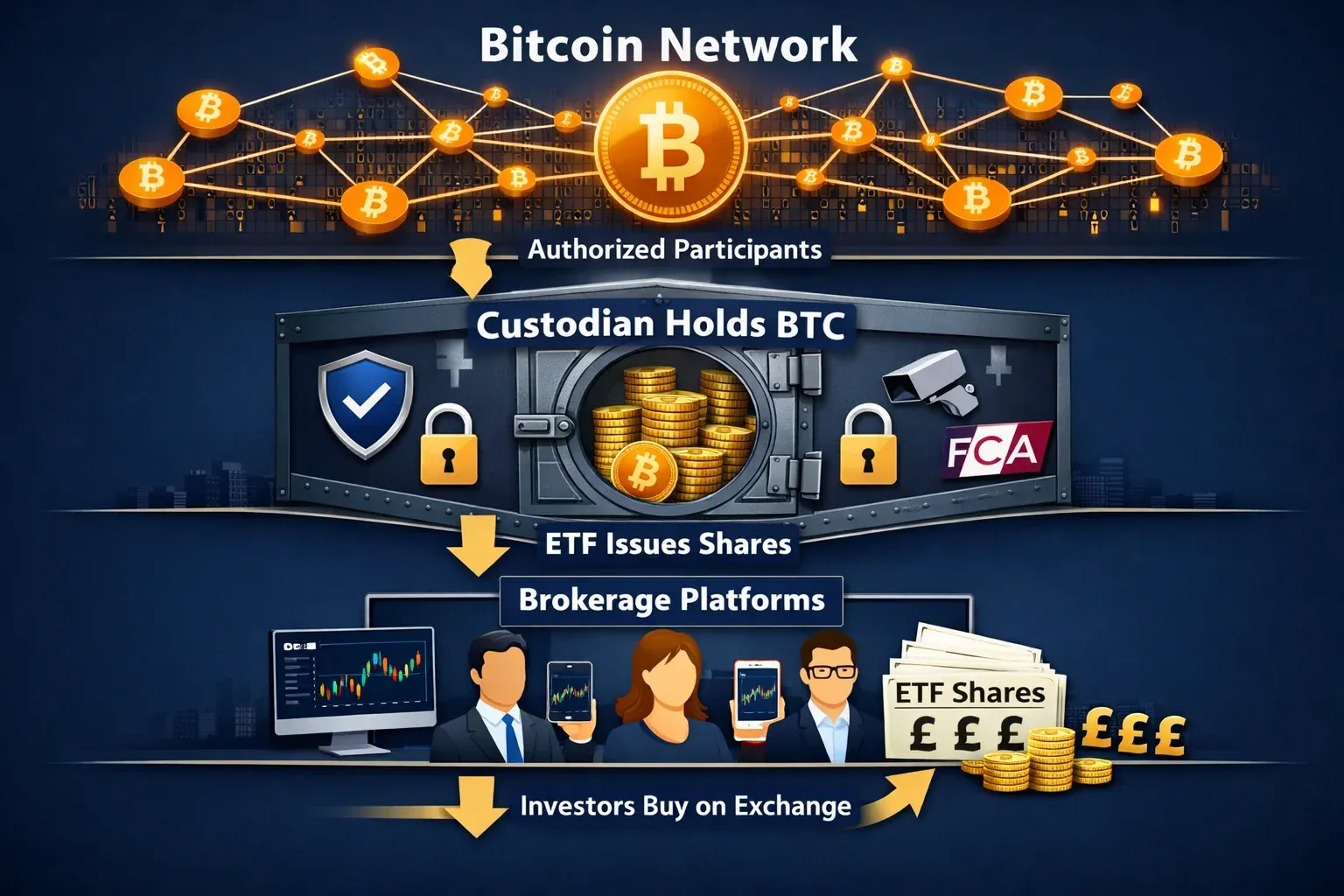
A Bitcoin exchange-traded fund is a regulated investment vehicle that tracks Bitcoin's price whilst trading on traditional stock exchanges. Unlike direct Bitcoin ownership, which requires cryptocurrency wallets and exchange accounts, Bitcoin ETFs allow investors to gain exposure through conventional brokerage platforms using pounds sterling.
The fundamental structure involves several key participants:
Authorised Participants (APs): Large financial institutions that create and redeem ETF shares by exchanging Bitcoin with the fund sponsor. This creation-redemption mechanism helps maintain the ETF's price alignment with Bitcoin's spot price.
Custodians: Regulated entities holding the physical Bitcoin on behalf of the ETF. Institutional-grade custody addresses security concerns that plague individual cryptocurrency storage.
Fund Sponsors: The issuer managing the ETF's operations, compliance, and investor communications. Major sponsors include BlackRock (iShares Bitcoin Trust,IBIT), Fidelity, and Grayscale.
Market Makers: Firms providing liquidity by continuously quoting buy and sell prices, ensuring investors can trade ETF shares efficiently during market hours.
Physical vs Synthetic Bitcoin ETFs
Bitcoin ETFs employ two primary structural approaches:
Physical (Spot) Bitcoin ETFs hold actual Bitcoin in custody. When investors purchase shares, the fund acquires corresponding Bitcoin through authorised participants. This direct backing provides transparent exposure, though it requires robust custody solutions and incurs storage costs.
Synthetic Bitcoin ETFs use derivatives,primarily Bitcoin futures contracts,to replicate Bitcoin's price movements without holding the underlying asset. Futures-based ETFs face contango costs (when futures trade at premiums to spot prices) and require continuous contract rolling, potentially creating tracking errors.
The UK regulatory environment, governed by the Financial Conduct Authority (FCA), has maintained restrictions on retail cryptocurrency derivatives, limiting synthetic Bitcoin ETF availability to professional investors. This regulatory stance reflects concerns about consumer protection and market volatility,concerns validated by Bitcoin's recent 50% decline. [3]
Creation and Redemption Process
The creation-redemption mechanism distinguishes ETFs from closed-end funds and represents a critical structural feature:
- Creation: When demand for ETF shares increases, authorised participants deliver Bitcoin to the fund sponsor, receiving newly created ETF shares in return
- Market Trading: These shares trade on exchanges throughout the day at market-determined prices
- Redemption: When demand decreases, APs return ETF shares to the sponsor, receiving Bitcoin in exchange
- Arbitrage: Price discrepancies between ETF shares and underlying Bitcoin create arbitrage opportunities, incentivising APs to maintain price alignment
This mechanism theoretically keeps ETF prices closely tracking Bitcoin's spot price. However, during periods of extreme volatility,such as the January 2026 outflows exceeding £1.5 billion,temporary dislocations can occur. [2]
Bitcoin ETF Benefits: Accessibility and Institutional Integration
Simplified Access Through Traditional Finance Infrastructure
Bitcoin ETFs eliminate several friction points that deter traditional investors from direct cryptocurrency ownership:
No Wallet Management: Investors avoid the technical complexity and security risks of managing private keys, seed phrases, and hardware wallets. The custodian assumes these responsibilities under regulatory oversight.
Familiar Trading Platforms: Purchases occur through existing brokerage accounts,Hargreaves Lansdown, Interactive Investor, or institutional platforms,using the same interface as equity or bond investments.
Sterling-Denominated Transactions: UK investors transact in pounds sterling without navigating cryptocurrency exchanges, foreign exchange spreads, or cross-border payment complexities.
Regulatory Protections: FCA-regulated platforms provide investor protections absent from many cryptocurrency exchanges, including compensation schemes and conduct standards.
Tax Efficiency Considerations for UK Investors
Bitcoin ETFs potentially offer tax advantages compared to direct cryptocurrency holdings, though professional tax advice remains essential:
Capital Gains Treatment: ETF gains qualify for capital gains tax treatment with the annual exempt amount (£3,000 for 2026/27 tax year). Direct cryptocurrency disposals also incur CGT, but ETF reporting may prove simpler.
ISA and SIPP Eligibility: Whilst cryptocurrency itself cannot be held in Individual Savings Accounts or Self-Invested Personal Pensions, certain Bitcoin ETFs may qualify for these tax-advantaged wrappers, subject to FCA eligibility criteria and platform availability.
Simplified Reporting: ETF transactions generate standard brokerage statements compatible with HMRC Self Assessment, whereas cryptocurrency transactions require detailed disposal records across multiple exchanges and wallets.
No Same-Day and 30-Day Rules Complexity: The share pooling rules for ETFs differ from the specific identification challenges of tracking individual cryptocurrency acquisitions across wallets and exchanges.
However, investors must recognise that tax efficiency depends on individual circumstances, holding periods, and evolving HMRC guidance on cryptocurrency taxation.
Institutional Adoption and Market Legitimacy
The entry of established financial institutions into Bitcoin ETFs represents a watershed moment for cryptocurrency legitimacy. Goldman Sachs holds £850 million in Bitcoin ETFs (primarily BlackRock's iShares Bitcoin Trust) and approximately £1.8 billion in total crypto exposure,a remarkable shift from the firm's earlier cryptocurrency skepticism. Learn more with our crypto tax calculator. [1]
This institutional participation provides several benefits:
Enhanced Liquidity: Large institutional flows increase market depth, potentially reducing bid-ask spreads and improving execution quality for all investors.
Professional Custody Standards: Institutional custodians employ multi-signature security, cold storage, insurance coverage, and operational controls exceeding typical retail exchange standards.
Regulatory Scrutiny: Institutional involvement attracts regulatory attention, potentially accelerating clearer frameworks and consumer protections.
Portfolio Integration: Bitcoin ETFs enable traditional portfolio construction methodologies, including rebalancing, tax-loss harvesting, and asset allocation models incorporating cryptocurrency exposure.
Yet institutional participation cuts both ways. The same institutions providing legitimacy can trigger substantial volatility through repositioning. Large Bitcoin holders transitioned to net sellers in early 2026, with analyst Andrew Moss noting "large BTC holders are selling into weakness." [3]
Bitcoin ETF Risks: Volatility, Fees, and Structural Considerations
Market Volatility and Price Correlation
Bitcoin's inherent volatility transfers directly to Bitcoin ETFs, with additional structural factors potentially amplifying price movements:
Underlying Asset Volatility: Bitcoin fell 50% from its October 2025 peak of approximately £97,000 to a low of £47,500 before recovering to around £54,000 by mid-February 2026. [3] [6] Bitcoin ETFs experienced proportional declines, demonstrating that regulatory wrappers provide no protection from underlying asset volatility.
Flow-Driven Amplification: ETF outflows can create selling pressure beyond organic market dynamics. The £1.5 billion in January 2026 outflows required corresponding Bitcoin sales by authorised participants, potentially accelerating price declines. [2]
Retail Capitulation: ETF investors, including retail participants on traditional finance platforms, demonstrated lower conviction during the downturn compared to long-term cryptocurrency holders, contributing to negative flows. [3]
Concentration Risk: As of February 2026, spot Bitcoin ETFs globally held 1.41 million BTC,approximately 6% of Bitcoin's total fixed supply. [2] This concentration means ETF flows exert disproportionate market influence, particularly during periods of coordinated institutional repositioning.
Management Fees and Tracking Errors
Bitcoin ETFs incur costs absent from direct cryptocurrency ownership:
Annual Management Fees: Typical spot Bitcoin ETF expense ratios range from 0.20% to 0.95% annually. Whilst competitive with actively managed funds, these fees exceed the negligible costs of self-custody for technically proficient investors.
Trading Costs: Bid-ask spreads, brokerage commissions, and platform fees add transaction costs, particularly for frequent traders or smaller positions.
Tracking Errors: The difference between ETF performance and Bitcoin's spot price arises from several sources:
- Management fees continuously eroding returns
- Cash drag from uninvested subscription proceeds
- Timing differences in creation-redemption processes
- Custodian operational costs
Premium/Discount Dynamics: During periods of extreme demand or selling pressure, ETF shares may trade at premiums or discounts to net asset value. The January 2026 outflows created temporary dislocations as market makers struggled to maintain orderly markets. [2]
Counterparty and Custodial Risks
Despite regulatory oversight, Bitcoin ETFs introduce counterparty dependencies:
Custodian Risk: The custodian holding Bitcoin on behalf of the ETF represents a single point of failure. Whilst institutional custodians employ robust security, they remain vulnerable to operational failures, internal fraud, or sophisticated attacks.
Authorised Participant Risk: The creation-redemption mechanism depends on APs maintaining orderly markets. During extreme stress, APs may widen spreads or reduce activity, impairing ETF liquidity.
Platform Risk: Investors access Bitcoin ETFs through brokerage platforms subject to their own operational and financial risks, though UK platforms benefit from Financial Services Compensation Scheme protections up to £85,000.
Regulatory Risk: Evolving cryptocurrency regulation could impact ETF operations, tax treatment, or availability. The FCA's cautious approach to retail cryptocurrency products reflects ongoing regulatory uncertainty.
Liquidity Considerations During Market Stress
The January 2026 outflows illuminated liquidity dynamics during market stress:
Flow Sensitivity: A one percentage point reallocation of gold ETF assets would represent approximately £4.3 billion,comparable to Bitcoin ETF outflows,highlighting how marginal flows influence the market. [2] Bitcoin ETFs, with smaller asset bases and higher volatility, demonstrate even greater flow sensitivity.
Market Hour Limitations: Bitcoin trades 24/7 globally, whilst Bitcoin ETFs trade only during stock exchange hours. Significant price movements during closed hours create gap risk and execution uncertainty.
Circuit Breakers and Halts: Traditional exchange trading halts during extreme volatility may prevent investors from exiting positions precisely when liquidity matters most.
Protected Bitcoin ETF Structures: Mitigating Downside Risk
Recent market turbulence has highlighted an emerging category: protected Bitcoin ETFs designed specifically to weather volatility. These structures performed notably better than traditional spot Bitcoin ETFs during the early 2026 downturn. [5]
How Protected ETFs Work
Protected Bitcoin ETFs employ options strategies to limit downside whilst maintaining upside participation:
Buffer Strategies: The ETF purchases put options providing downside protection (e.g., limiting losses to 10-15%) whilst maintaining exposure to Bitcoin appreciation, typically with capped upside.
Collar Strategies: Combining purchased put options (downside protection) with sold call options (upside limitation) to finance the protective puts, creating a defined return range.
Defined Outcome Structures: Establishing specific protection levels, participation rates, and outcome periods (typically quarterly or annually), providing clarity on risk-return parameters.
Trade-offs and Suitability
Protected structures involve explicit trade-offs:
Reduced Upside: Capped gains limit participation in strong Bitcoin rallies, potentially underperforming during bull markets.
Higher Costs: Options premiums increase management fees, typically ranging from 0.85% to 1.50% annually.
Complexity: Understanding protection mechanisms, reset dates, and outcome scenarios requires greater financial sophistication than simple spot ETFs.
Outcome Period Timing: Entering mid-period may result in asymmetric protection, as buffer levels reset periodically.
For risk-averse investors seeking Bitcoin exposure or those implementing cycle-aware strategies, protected ETFs offer a middle ground between full volatility exposure and complete avoidance. However, they suit specific risk profiles rather than representing universally superior structures.
Professional Standards and Investor Protection
The volatility and complexity surrounding Bitcoin ETFs underscore why professional standards matter. TrustCrypto Institute's assessment-led certification programmes exist precisely to raise the baseline for crypto advisory competence.
The Role of Qualified Advisors
Investors navigating Bitcoin ETF explained: structure, benefits, and risks benefit from advisors who understand:
Regulatory Frameworks: FCA guidance on cryptocurrency promotion, suitability assessments, and risk disclosure requirements specific to high-volatility assets.
Tax Implications: HMRC treatment of ETF gains, ISA eligibility, pension suitability, and reporting obligations,areas where generic cryptocurrency advice often falls short.
Portfolio Construction: Appropriate allocation sizing, rebalancing methodologies, and correlation analysis within broader investment strategies.
Risk Assessment: Evaluating investor risk tolerance, time horizons, and financial circumstances against Bitcoin's volatility profile and recent market behaviour.
Product Selection: Comparing spot versus futures-based ETFs, protected structures, fee levels, tracking accuracy, and custodian quality across providers.
Verification and Transparency
Investors should demand verified credentials when seeking cryptocurrency advisory services. TrustCrypto's Certified Crypto Advisor (TCCA) designation provides public verification of professional competence through rigorous assessment, not merely course completion.
The distinction matters: substance over speculation, evidence-based guidance over promotional hype, and long-term perspective over short-term trading signals. The January 2026 outflows demonstrate how quickly sentiment shifts,qualified professionals help investors maintain discipline through market cycles. [3]
Comparing Bitcoin ETFs to Direct Cryptocurrency Ownership
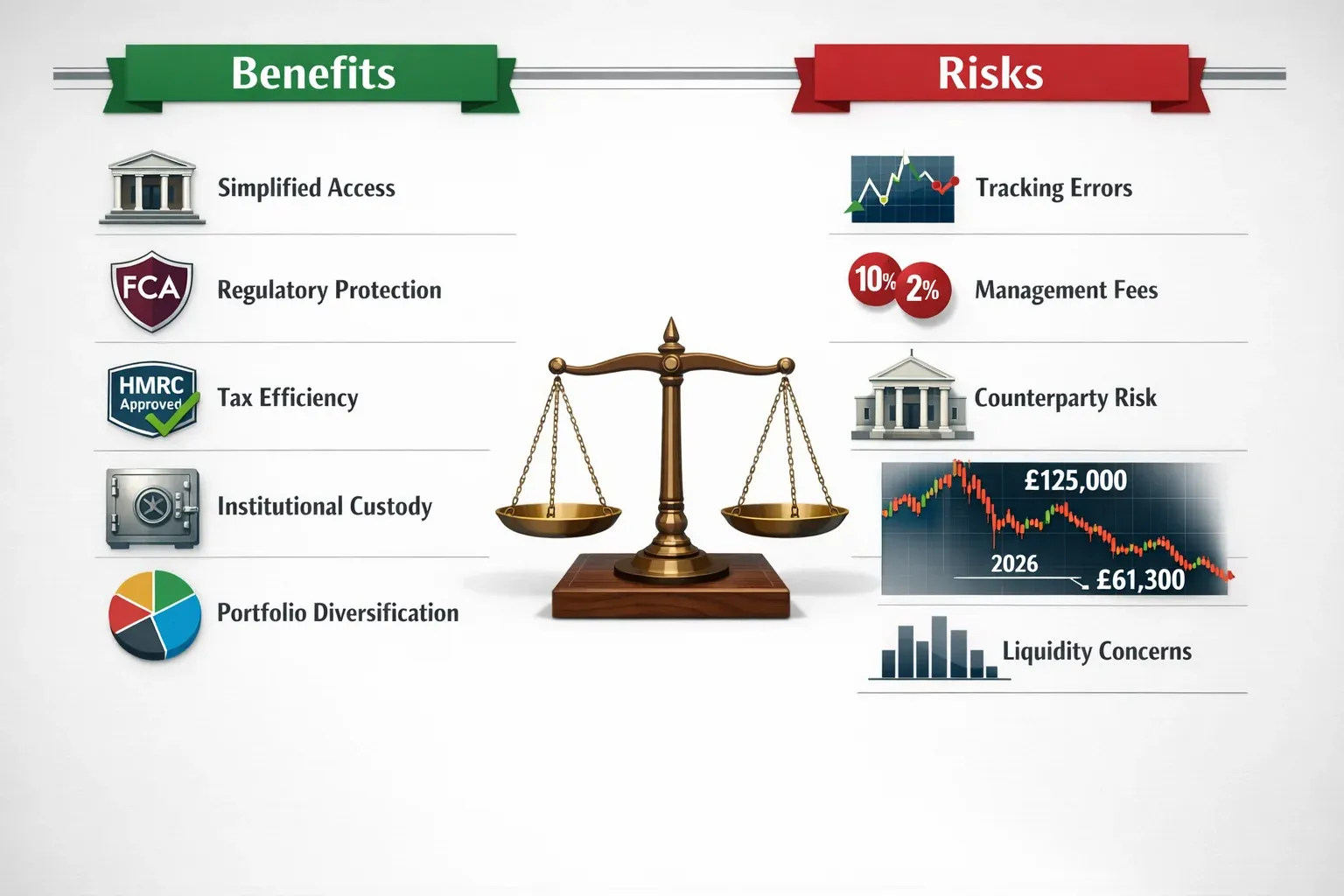
Understanding when Bitcoin ETFs suit investor needs versus direct ownership requires honest assessment:
When Bitcoin ETFs Make Sense
Traditional Finance Integration: Investors with substantial assets in conventional portfolios seeking modest cryptocurrency allocation (e.g., 1-5%) benefit from ETF simplicity and platform integration.
Security Concerns: Those uncomfortable managing private keys or lacking technical proficiency reduce custody risk through institutional custodians.
Tax-Advantaged Accounts: Investors prioritising ISA or pension wrappers may accept ETF fees for tax benefits, subject to platform availability.
Regulatory Comfort: Risk-averse investors value FCA oversight and traditional brokerage protections over cryptocurrency exchange environments.
Estate Planning: ETFs simplify inheritance through standard brokerage transfer processes versus cryptocurrency estate planning complexities.
When Direct Ownership May Be Preferable
Cost Sensitivity: Long-term holders avoiding frequent trading may prefer eliminating ongoing management fees, particularly for larger positions where percentage fees become material.
True Self-Custody: Those valuing "not your keys, not your coins" philosophy and willing to implement robust security practices maintain complete control through direct ownership.
24/7 Trading: Active traders requiring round-the-clock market access and immediate execution need direct cryptocurrency exchange access.
Yield Generation: Direct ownership enables participation in staking, lending, or DeFi protocols (with corresponding risks) unavailable through traditional ETFs.
Philosophical Alignment: Investors attracted to Bitcoin's decentralisation ethos may find ETF intermediation philosophically inconsistent.
The choice involves trade-offs between convenience and control, regulatory protection and self-sovereignty, simplicity and flexibility. Neither approach is universally superior,suitability depends on individual circumstances, technical capability, and investment objectives.
Market Context: 2026 Volatility and Institutional Behaviour
Recent market dynamics provide essential context for Bitcoin ETF evaluation:
The January 2026 Outflows
US spot Bitcoin ETFs experienced the second and third largest outflows since inception during the weeks of January 19 and 26, 2026, followed by substantial additional outflows on February 4. [2] [3] These flows coincided with Bitcoin's 50% decline from its October 2025 peak.
Several factors contributed to this institutional repositioning:
Profit-Taking: Bitcoin's rally to approximately £97,000 in October 2025 created substantial unrealised gains, prompting tactical reallocation.
Risk-Off Sentiment: Broader market uncertainty drove flows toward traditional safe havens, with gold making 53 new all-time highs whilst Bitcoin ETFs bled billions. [2]
Whale Behaviour: Large Bitcoin holders transitioned from accumulation (early January) to distribution (late January onwards), creating selling pressure that ETF flows amplified. [3]
Retail Capitulation: ETF investors demonstrated lower conviction than long-term cryptocurrency holders, contributing to outflow acceleration during price declines. [3]
Institutional Positioning
Despite outflows, institutional infrastructure remains in place. Goldman Sachs maintains £850 million in Bitcoin ETF exposure, representing continued conviction despite short-term volatility. [1] This institutional presence provides:
Market Maturity: Established financial institutions bring operational sophistication, risk management frameworks, and professional standards.
Regulatory Engagement: Institutional participation accelerates regulatory clarity as authorities engage with recognised entities rather than fragmented cryptocurrency operators.
Infrastructure Development: Custody solutions, trading systems, and compliance frameworks built for institutional clients benefit the broader ecosystem.
However, institutional participation also introduces correlation with traditional finance risk appetite. Bitcoin ETFs no longer trade purely on cryptocurrency-specific factors,they respond to equity market sentiment, interest rate expectations, and macroeconomic conditions affecting institutional portfolios.
Future Outlook and Regulatory Developments
The Bitcoin ETF landscape continues evolving across several dimensions:
UK Regulatory Trajectory
The FCA maintains a cautious approach to retail cryptocurrency products, reflecting concerns about volatility, consumer understanding, and market integrity. Future developments may include:
Clearer Promotion Standards: Enhanced guidance on cryptocurrency ETF marketing, risk disclosure, and suitability assessments for UK investors.
Potential Retail Access: Gradual expansion of retail cryptocurrency product availability as markets mature and investor education improves, though significant restrictions likely remain.
Custody Requirements: Evolving standards for cryptocurrency custodians serving UK investors, potentially including capital requirements, insurance mandates, and operational controls.
Tax Clarity: Further HMRC guidance on cryptocurrency taxation, ISA eligibility, and pension suitability as adoption increases.
Product Innovation
Bitcoin ETF structures continue developing:
Staking Integration: Some ETF sponsors exploring staking revenue (for proof-of-stake cryptocurrencies) to offset management fees, though Bitcoin's proof-of-work consensus precludes direct staking.
Active Management: Strategies employing tactical allocation, volatility management, or cryptocurrency selection beyond passive Bitcoin tracking.
Multi-Asset Crypto ETFs: Diversified cryptocurrency exposure across Bitcoin, Ethereum, and other digital assets within single ETF structures.
ESG Considerations: Addressing environmental concerns through carbon-neutral Bitcoin mining exposure or proof-of-stake cryptocurrency focus.
Market Maturation
As Bitcoin ETFs mature, several trends appear likely:
Fee Compression: Competitive pressure driving management fees lower, particularly for plain-vanilla spot Bitcoin exposure.
Improved Tracking: Enhanced authorised participant activity and custodian efficiency reducing tracking errors.
Greater Liquidity: Expanding asset bases and market maker participation improving bid-ask spreads and execution quality.
Institutional Integration: Continued incorporation into traditional portfolio construction, risk models, and asset allocation frameworks.
Conclusion: Informed Decision-Making in a Volatile Asset Class
Bitcoin ETF explained: structure, benefits, and risks reveals a nuanced investment vehicle offering genuine advantages alongside material limitations. The regulatory wrapper, institutional custody, and traditional finance integration provide accessibility and protection absent from direct cryptocurrency ownership. Yet management fees, tracking errors, counterparty dependencies, and flow-driven volatility introduce costs and risks requiring careful evaluation.
The January 2026 outflows exceeding £1.5 billion and Bitcoin's 50% price decline underscore that ETF structures provide no protection from underlying asset volatility. [2] [3] Investors attracted by convenience must maintain realistic expectations about risk,regulatory oversight cannot eliminate market volatility, and institutional participation can amplify rather than dampen price movements during stress periods.
Actionable Next Steps
For investors considering Bitcoin ETF exposure:
- Assess Suitability: Honestly evaluate risk tolerance, investment time horizon, and financial circumstances against Bitcoin's demonstrated volatility
- Understand Structures: Compare spot versus futures-based ETFs, protected structures, fee levels, and custodian quality across available products
- Calculate Costs: Model management fees, trading costs, and potential tracking errors against investment size and holding period
- Consider Alternatives: Evaluate whether direct ownership, protected ETFs, or complete avoidance better suits individual circumstances
- Seek Qualified Advice: Engage advisors with verified cryptocurrency competence, regulatory knowledge, and evidence-based methodologies rather than promotional hype
For financial professionals advising on cryptocurrency:
- Pursue Rigorous Education: Develop genuine expertise through assessment-led certification rather than superficial familiarity
- Maintain Regulatory Compliance: Ensure cryptocurrency advice meets FCA promotion standards, suitability requirements, and risk disclosure obligations
- Adopt Evidence-Based Frameworks: Ground recommendations in market cycles, on-chain data, and regulatory developments rather than speculation
- Prioritise Client Protection: Implement appropriate allocation sizing, rebalancing discipline, and ongoing suitability reviews
- Demonstrate Professional Standards: Pursue verified credentials that signal competence and ethical commitment to clients and regulators
The cryptocurrency advisory profession stands at a critical juncture. As Bitcoin ETFs bring digital assets into traditional finance, the industry needs professionals who combine technical cryptocurrency knowledge with financial planning competence and regulatory understanding. TrustCrypto Institute exists to raise this baseline,establishing clear frameworks, rigorous assessment, and transparent standards that protect investors whilst enabling qualified professionals to serve this emerging market.
Bitcoin ETFs represent neither cryptocurrency panacea nor inherently flawed structure. They are tools,useful for specific purposes, unsuitable for others, and requiring informed deployment within broader investment strategies. Understanding their mechanics, recognising their limitations, and maintaining realistic expectations separates prudent portfolio construction from speculation dressed as investment.
The market volatility of early 2026 provides valuable lessons: institutional participation brings liquidity and legitimacy but also correlation with traditional finance sentiment. regulatory wrappers provide operational protections but cannot eliminate underlying asset risk. and convenient access without genuine understanding creates vulnerability during inevitable market stress.
Standards matter. Competence matters. Professional accountability matters. As cryptocurrency integration into traditional finance accelerates, these principles become increasingly critical for both advisors serving clients and investors evaluating their guidance.
Related Resources
Explore these helpful tools and guides:
Take the Next Step
Ready to advance your crypto expertise? Explore our professional certification programmes to enhance your credentials.
References
- [1] Goldman Sachs Position In Bitcoin - https://bitcoinmagazine.com/news/goldman-sachs-position-in-bitcoin
- [2] Why Bitcoin Etfs Bleed Billions While Gold Makes 53 New All Time Highs With 559b In Demand - https://cryptoslate.com/why-bitcoin-etfs-bleed-billions-while-gold-makes-53-new-all-time-highs-with-559b-in-demand/
- [3] Bitcoin Price Whales Etf Baling Out Ubs Crypto Is Not An Asset - https://fortune.com/2026/02/06/bitcoin-price-whales-etf-baling-out-ubs-crypto-is-not-an-asset/
- [5] Crypto Winter Calls Protected Bitcoin Exposure - https://www.etftrends.com/alternatives-content-hub/crypto-winter-calls-protected-bitcoin-exposure/
- [6] Watch - https://www.youtube.com/watch?v=tYwrzJDN2wM