

The landscape of crypto wealth management in the UK continues to evolve rapidly as institutional investors seek professional guidance for their digital asset portfolios. Learn more with our crypto tax calculator. Leading firms now offer sophisticated solutions that bridge traditional finance with cryptocurrency investments, providing the security and expertise that high-net-worth clients demand. Explore more in our Finance section.
The wealth management landscape has transformed dramatically. High-net-worth individuals holding significant cryptocurrency portfolios no longer face the binary choice between traditional private banks offering zero crypto expertise and unregulated crypto platforms lacking institutional safeguards. In 2026, crypto wealth management services for high net worth clients have matured into sophisticated, compliance-first offerings that bridge both worlds,combining the rigour of traditional wealth management with the innovation of digital assets.
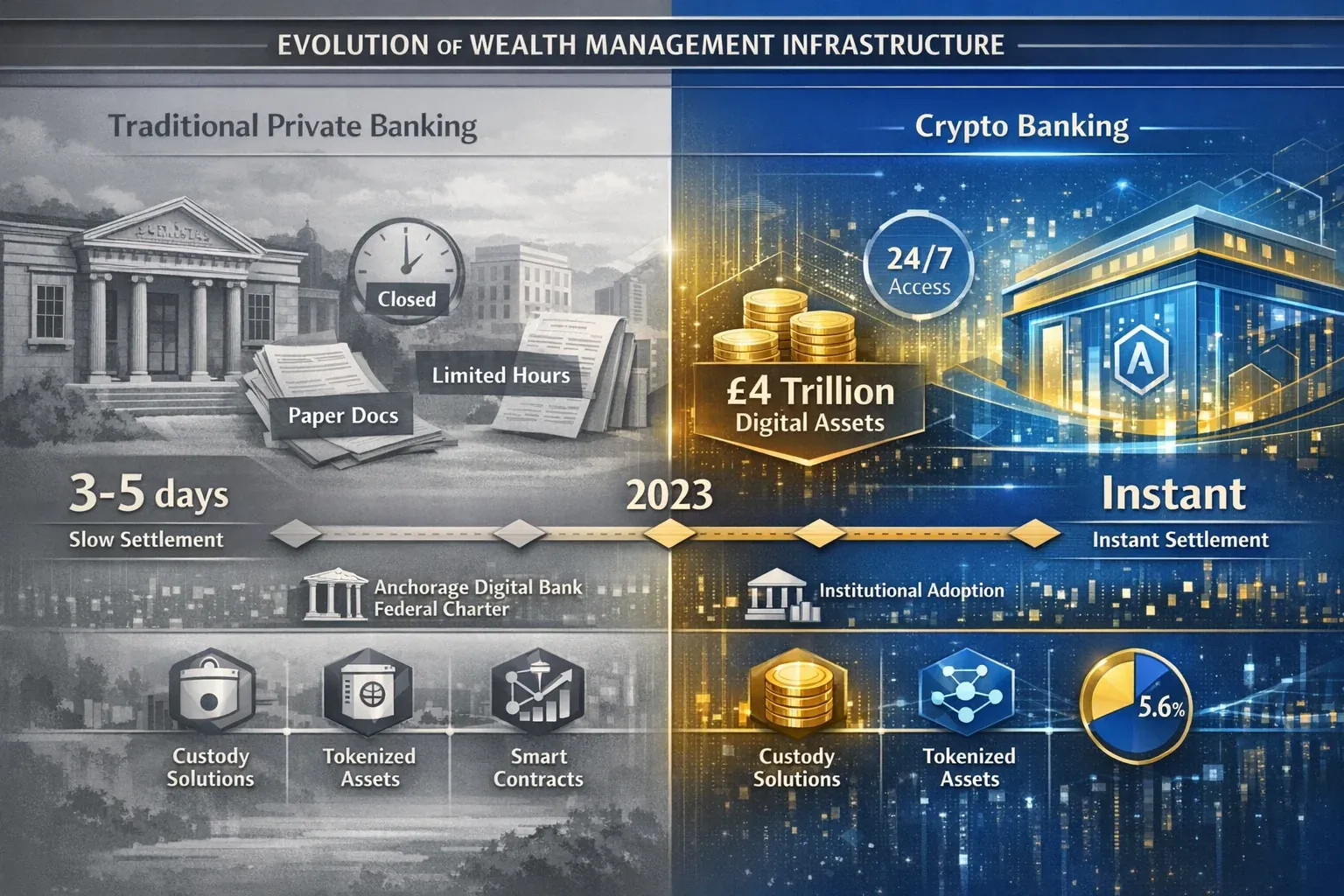
With digital assets reaching approximately £3.2 trillion globally and institutional investors projected to allocate 5.6% of portfolios to tokenized assets by 2026, the question is no longer whether crypto belongs in wealth management, but rather how to access these services through properly credentialed, FCA-compliant professionals. [2] [7]
The Evolution of Crypto Wealth Management Infrastructure
From Regulatory Uncertainty to Institutional Acceptance
The journey from Bitcoin's early days to today's institutional-grade crypto wealth management infrastructure represents one of the most significant shifts in financial services. Traditional wealth managers who dismissed digital assets as speculative novelties now face clients demanding sophisticated crypto strategies.
Anchorage Digital Bank stands as a watershed moment,the first federally chartered crypto bank offering SEC custody-rule-compliant solutions specifically designed for wealth managers and institutional fund managers. [1] This regulatory milestone signaled that crypto infrastructure could meet the same standards applied to traditional assets.
By 2026, major institutions have followed suit. Bank of America and Vanguard have approved crypto assets for wealth management portfolios, providing the institutional validation that high-net-worth clients require before committing significant capital. [8] This acceptance doesn't represent capitulation to hype, but rather recognition that digital assets have matured into a legitimate asset class requiring proper management.
Blockchain Rails: The Technical Foundation
The infrastructure underpinning crypto wealth management differs fundamentally from traditional private banking systems. Blockchain rails enable near-instant settlement of complex transactions that would require 3-5 days at traditional private banks. [2] This isn't merely a convenience,it represents a structural advantage that enables more sophisticated portfolio management strategies.
Consider a scenario where a wealth manager needs to rebalance a client's portfolio across multiple asset classes, including tokenized real estate, cryptocurrency holdings, and traditional securities. On blockchain rails, this entire workflow can execute in minutes with full auditability, compared to the multi-day settlement cycles that create execution risk and opportunity cost in traditional systems.
The technical capabilities extend beyond speed. Smart contracts enable automated compliance checks, programmable custody arrangements, and transparent fee structures that traditional systems struggle to match. For high-net-worth clients accustomed to opacity in fee arrangements, this transparency represents a significant improvement.
Comprehensive Service Offerings for High Net Worth Crypto Clients
Core Wealth Management Services
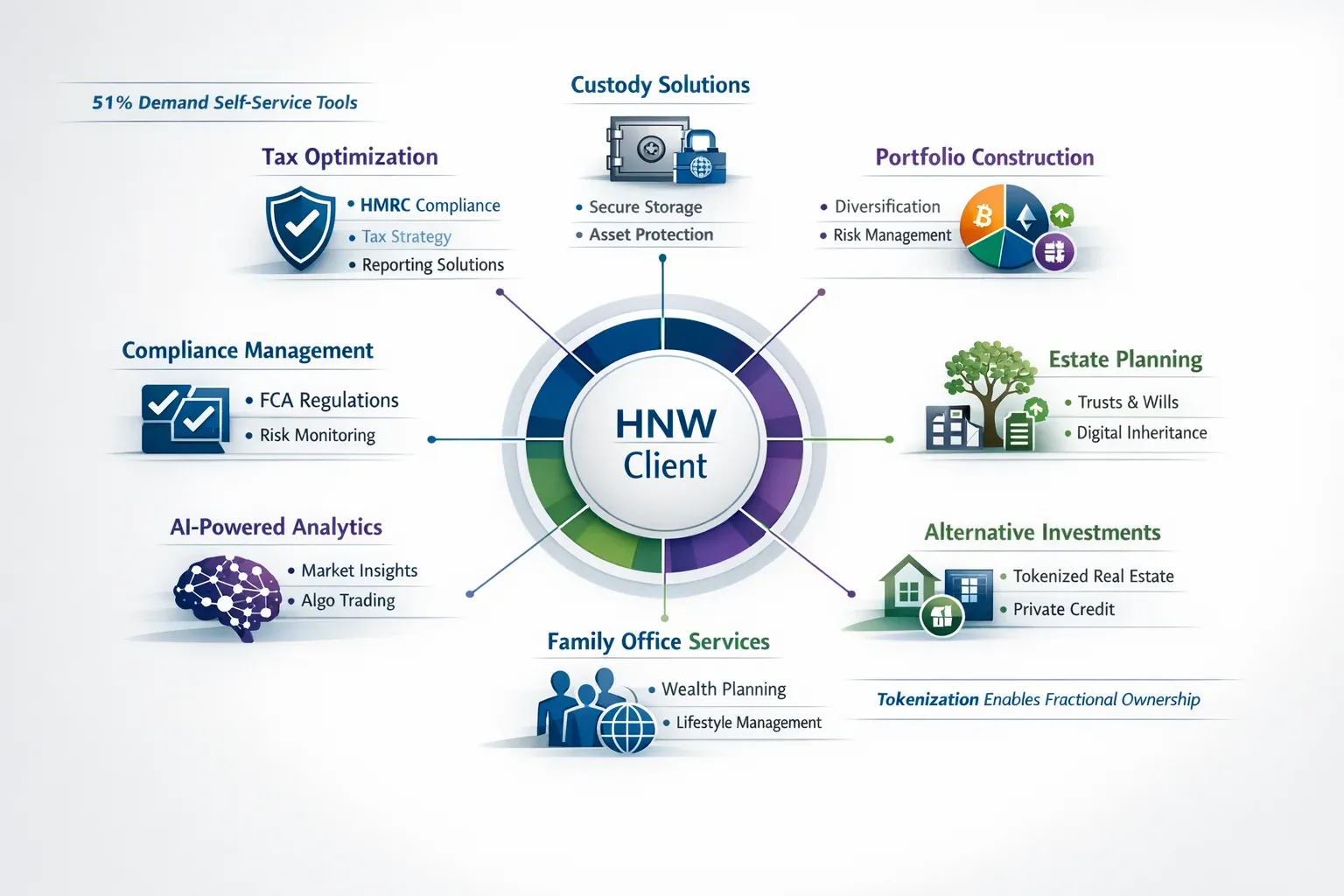
Professional crypto wealth management for high-net-worth individuals encompasses far more than simply "buying and holding" digital assets. The service spectrum mirrors traditional private banking whilst incorporating crypto-specific considerations:
Portfolio Construction and Asset Allocation forms the foundation. Qualified advisors assess a client's overall financial position, risk tolerance, time horizon, and objectives before determining appropriate crypto exposure. This might range from 2-3% for conservative clients to 15-20% for those with higher risk tolerance and longer time horizons.
The portfolio itself extends beyond Bitcoin and Ethereum. In 2026, sophisticated allocations include:
- Core digital assets (BTC, ETH) for foundational exposure
- Tokenized traditional assets including real estate, private credit, and commodities
- DeFi protocol tokens offering yield generation opportunities
- Stablecoins for liquidity management and yield optimisation
- Alternative crypto assets providing diversification and growth potential
Custody Solutions represent perhaps the most critical service component. High-net-worth clients require institutional-grade custody that eliminates single points of failure whilst maintaining accessibility. Solutions range from multi-signature cold storage to qualified custodians like Anchorage Digital that meet SEC custody rule requirements. [1]
The custody conversation must address inheritance planning,ensuring that digital assets can transfer to beneficiaries without the private key horror stories that plague self-custody arrangements.
Tax Optimisation and HMRC Compliance
UK tax treatment of cryptocurrency creates significant complexity that demands specialist expertise. High-net-worth individuals face Capital Gains Tax on crypto disposals, with allowances and rates that differ substantially from traditional securities.
Professional crypto wealth managers provide:
- Transaction tracking and cost basis calculation across multiple exchanges, wallets, and protocols
- Tax-loss harvesting strategies to offset gains whilst maintaining portfolio exposure
- Timing optimisation for disposals to maximise allowances across tax years
- Inheritance tax planning for crypto holdings within estate structures
- HMRC reporting compliance including Self Assessment disclosures
The complexity multiplies for clients with international holdings, DeFi protocol participation, or crypto earned through staking and yield farming. Each activity carries distinct tax implications that require careful documentation and strategic planning.
Estate Planning and Succession
Digital assets introduce unique estate planning challenges. Unlike traditional assets held by custodians who can transfer ownership upon death, cryptocurrency held in self-custody becomes permanently inaccessible without proper key management and succession planning.
Comprehensive crypto wealth management addresses:
- Secure key backup and recovery procedures that balance security with accessibility
- Trustee education ensuring executors understand digital asset management
- Multi-signature arrangements requiring multiple parties to authorise transfers
- Letter of wishes providing clear instructions for crypto asset distribution
- Regular access testing confirming that succession procedures actually work
Forward-thinking advisors incorporate smart contract-based solutions that can automatically execute inheritance provisions based on predefined conditions, providing certainty that traditional estate administration struggles to match.
Advanced Services: Tokenization and Alternative Investments
The Tokenization Revolution
Tokenization mechanisms are enabling fractional ownership of high-value assets like commercial real estate and fine art, lowering minimum investment thresholds previously accessible only to ultra-high-net-worth investors. [4] This represents one of the most significant developments in wealth management accessibility.
A high-net-worth client with £500,000 to invest can now access:
- Commercial property portfolios with minimum investments of £10,000-50,000 rather than £1-5 million
- Private credit opportunities offering 8-12% yields with enhanced liquidity through tokenization
- Venture capital and private equity positions with fractional ownership and secondary market access
- Collectibles and alternative assets including art, wine, and classic cars with transparent pricing
The tokenization infrastructure enables 24/7 trading and near-instant settlement that traditional alternative investments cannot match. A client needing liquidity from a tokenized real estate position can potentially exit within hours rather than the months or years required for direct property holdings.
Institutional investors are projected to allocate 5.6% of portfolios to tokenized assets by 2026, validating the model and ensuring robust secondary markets. [7] This institutional participation provides the liquidity and price discovery that early tokenization platforms lacked.
Private Credit and Yield Generation
Private credit is expanding rapidly as traditional banks tighten lending standards, creating attractive yield opportunities for individual investors seeking income. [4] Crypto-native lending protocols and tokenized credit instruments provide high-net-worth clients with:
- Enhanced yields compared to traditional fixed income (often 6-10% vs 3-5%)
- Diversification from public market correlation
- Transparency through blockchain-based reporting
- Liquidity options via tokenized credit positions
Professional wealth managers conduct thorough due diligence on lending protocols, assessing smart contract security, collateralization ratios, counterparty risk, and regulatory compliance. The yield advantage means nothing if principal is lost to protocol exploits or fraud.
Technology-Enabled Service Delivery
Agentic AI and Autonomous Workflows
Agentic AI is replacing standard automation, moving beyond chatbots to autonomously execute complex workflows like compliance checks and portfolio rebalancing based on client intents. [4] This represents a fundamental shift in how wealth management services are delivered.
Bank of America's Erica AI platform demonstrates real-world evolution, shifting from generative chatbots toward autonomous action-taking and workflow orchestration. [4] In the crypto wealth management context, agentic AI can:
- Monitor portfolios continuously and execute rebalancing when allocations drift beyond thresholds
- Conduct automated compliance screening for new investment opportunities
- Generate tax optimisation recommendations based on current holdings and market conditions
- Provide instant responses to client queries about portfolio performance and market developments
- Execute complex multi-step transactions including cross-chain swaps and yield optimisation strategies
The technology doesn't replace human advisors but rather augments their capabilities, handling routine tasks whilst freeing professionals to focus on strategic planning and relationship management.
Self-Service Tools and Client Portals
51% of high-net-worth individuals now demand self-service tools and advanced technologies to support portfolio management and everyday interactions. [3] This expectation has driven development of sophisticated client portals that provide:
- Real-time portfolio visibility across all holdings including crypto, traditional assets, and tokenized investments
- Performance analytics with customizable benchmarks and attribution analysis
- Tax reporting dashboards showing unrealized gains, cost basis, and optimisation opportunities
- Document libraries providing secure access to statements, tax documents, and planning materials
- Communication tools enabling secure messaging with advisory teams
The best platforms balance self-service capability with human expertise, recognising that high-net-worth clients value both autonomy and access to qualified professionals when needed.
The Family Office Model for High Net Worth Segments
The "Family Office" model,offering holistic advice on tax, legal, health, and lifestyle,is scaling down to serve high-net-worth and mass affluent segments through technology enablement. [4] What was once reserved for ultra-high-net-worth families with £50+ million is now accessible to clients with £500,000-5 million through shared family office structures and technology platforms.
For crypto wealth management, this holistic approach addresses:
- Coordinated tax planning across crypto holdings, traditional investments, business interests, and property
- Legal structuring including trusts, companies, and offshore arrangements optimised for digital assets
- Risk management encompassing insurance, cybersecurity, and asset protection strategies
- Lifestyle management including crypto-friendly banking relationships and payment solutions
- Next-generation education preparing heirs to manage digital asset inheritances responsibly
This comprehensive approach recognises that high-net-worth clients don't compartmentalize their financial lives,they need integrated solutions that address the full complexity of their situations.
Selecting Qualified Crypto Wealth Management Professionals
The Credential Gap and Professional Standards
The rapid growth of crypto wealth management has created a dangerous credential gap. Traditional wealth managers lack crypto expertise, whilst crypto enthusiasts lack proper financial planning qualifications. High-net-worth clients deserve professionals who combine both competencies.
Assessment-led certification from independent standards bodies provides essential quality assurance. TrustCrypto Institute's certification pathways,including the Certified Crypto Advisor (TCCA) designation,establish clear frameworks for evaluating professional competence in both traditional wealth management and crypto-specific knowledge.
When evaluating potential advisors, high-net-worth clients should verify:
- Professional qualifications including traditional credentials (CFA, CFP, DipPFS) and crypto-specific certifications
- FCA authorisation and compliance with Financial Promotion Rules
- Published methodology demonstrating evidence-based, cycle-aware investment approaches
- Transparent fee structures with clear disclosure of all compensation arrangements
- Professional indemnity insurance providing client protection
- Continuing professional development showing commitment to maintaining current knowledge
The public verification capabilities offered by certification bodies enable clients to confirm credentials independently rather than relying solely on advisor representations.
Red Flags and Warning Signs
High-net-worth individuals should approach crypto wealth management with healthy skepticism, watching for warning signs including:
- ❌ Guaranteed returns or performance projections that ignore market cycles
- ❌ Pressure to invest quickly without proper due diligence and planning
- ❌ Lack of regulatory authorisation or evasive responses about compliance
- ❌ Excessive concentration in single assets or strategies
- ❌ Opaque fee structures with hidden costs or conflicts of interest
- ❌ Social media hype prioritizing promotion over professional analysis
- ❌ Resistance to independent verification of credentials or track records
Professional advisors welcome scrutiny and provide transparent answers to all client questions. Those who don't deserve immediate dismissal from consideration.
Regulatory Landscape and Consumer Protection
FCA Oversight and Financial Promotions
The Financial Conduct Authority has established clear requirements for crypto-related financial promotions, requiring that communications be fair, clear, and not misleading. High-net-worth clients benefit from these protections even when they qualify as sophisticated or high-net-worth investors under FCA definitions.
Professional crypto wealth managers ensure:
- Risk warnings appear prominently in all communications
- Balanced presentation acknowledging both opportunities and risks
- Substantiated claims with evidence supporting any performance or benefit statements
- Appropriate targeting ensuring promotions reach only suitable audiences
- Clear fee disclosure with no hidden costs or conflicts
The regulatory framework continues evolving, with consultation papers and policy statements regularly updating requirements. Advisors committed to compliance-first approaches monitor these developments and adjust practices accordingly.
Custody and Asset Protection
Following numerous exchange failures and fraud cases, custody arrangements demand particular attention. High-net-worth clients should understand:
- Segregation of assets ensuring client holdings remain separate from firm assets
- Proof of reserves providing cryptographic verification of custodian solvency
- Insurance coverage protecting against theft, loss, or custodian failure
- Regulatory status of custody providers and applicable protections
- Recovery procedures in the event of custodian insolvency or operational failure
The Financial Services Compensation Scheme (FSCS) does not currently cover cryptocurrency holdings, making due diligence on custody arrangements absolutely critical.
Conclusion: The Path Forward for High Net Worth Crypto Investors
Crypto wealth management has evolved from a niche service offered by unregulated enthusiasts to a sophisticated discipline delivered by properly credentialed professionals at major institutions. High-net-worth individuals in 2026 can access comprehensive services that rival or exceed traditional private banking whilst incorporating the innovation and efficiency of digital assets.
The key to successful outcomes lies in selecting qualified professionals who demonstrate:
- ✅ Verified credentials from independent standards bodies
- ✅ FCA compliance and transparent regulatory status
- ✅ Evidence-based methodology grounded in sound financial planning principles
- ✅ Comprehensive service offerings addressing the full complexity of crypto wealth management
- ✅ Long-term perspective that acknowledges market cycles and prioritizes sustainable outcomes
Actionable Next Steps
For high-net-worth individuals seeking professional crypto wealth management:
- Verify advisor credentials through TrustCrypto Institute's public directory of certified professionals
- Request detailed service descriptions covering portfolio construction, custody, tax planning, and estate planning
- Understand fee structures completely before engaging services
- Confirm regulatory authorisation through the FCA register
- Start with comprehensive planning before making investment decisions
- Demand transparency in all aspects of the advisory relationship
The convergence of traditional wealth management expertise with crypto-native innovation creates unprecedented opportunities for high-net-worth investors. Success requires partnering with professionals who combine both competencies whilst maintaining the highest standards of conduct and ethics.
Standards matter. In a market still maturing, professional accountability and verified credentials provide the foundation for trust. High-net-worth individuals deserve nothing less than properly qualified advisors operating within clear regulatory frameworks and transparent professional standards.
Related Resources
Explore these helpful tools and guides:
Take the Next Step
Ready to advance your crypto expertise? Explore our professional certification programmes to enhance your credentials.
References
- [1] Wealth Managers - https://www.anchorage.com/who-we-serve/wealth-managers
- [2] Crypto Banking New Ultra High Net Worth Infrastructure - https://www.henleyglobal.com/publications/crypto-wealth-report-2025/crypto-banking-new-ultra-high-net-worth-infrastructure
- [3] Top Digital Wealth Management Trends - https://www.unblu.com/en/blog/top-digital-wealth-management-trends/
- [4] Top Wealth Management Trends In 2026 The Shift To Agentic Ai And Private Markets - https://www.investsuite.com/insights/blogs/top-wealth-management-trends-in-2026-the-shift-to-agentic-ai-and-private-markets
- [7] Tokenization In Asset Management - https://www.ey.com/en_us/insights/financial-services/tokenization-in-asset-management
- [8] investmentnews - https://www.investmentnews.com/alternatives/crypto-in-2026/263547