

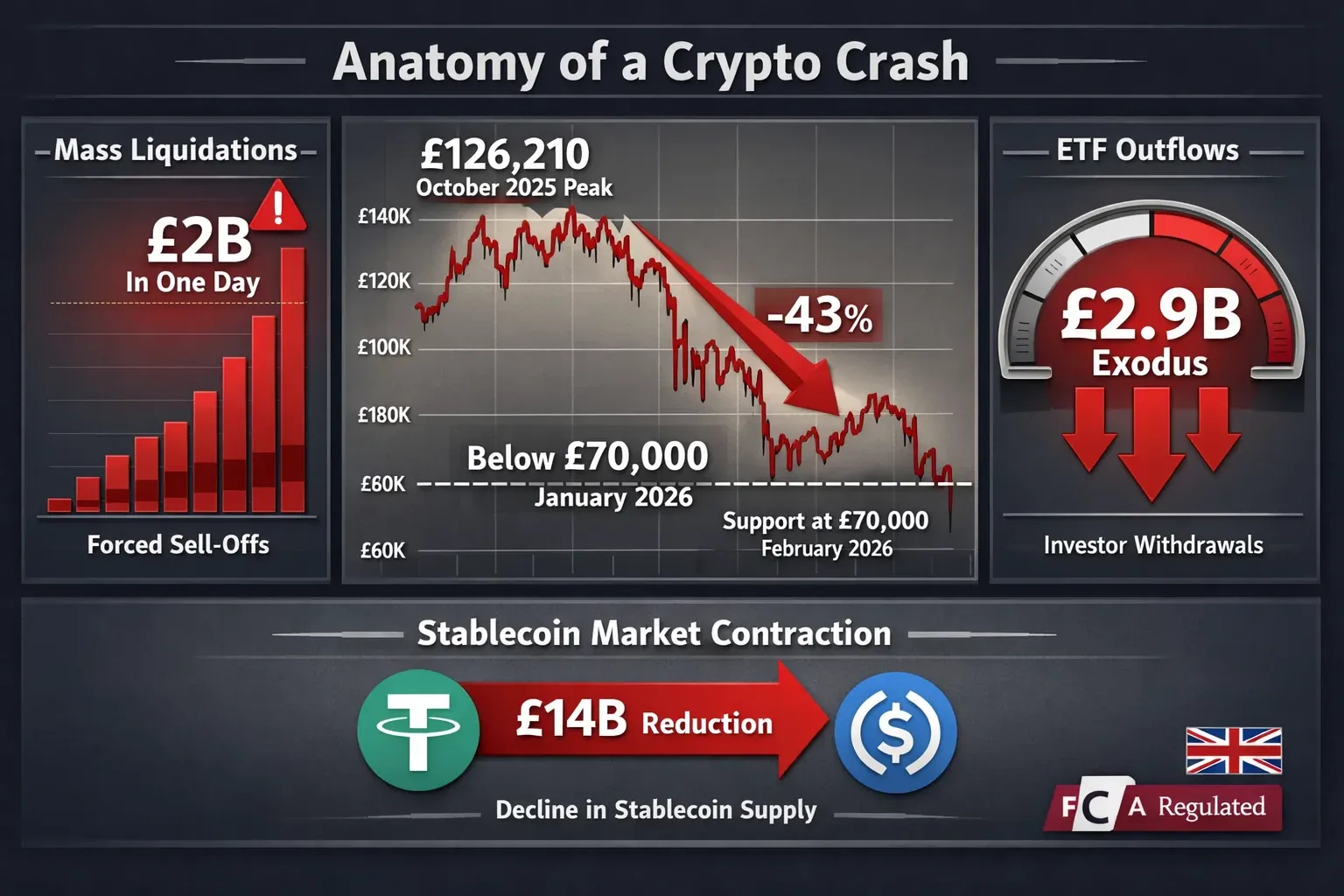
When Bitcoin plummeted more than 43% from its all-time high of £126,210.50 in October 2025 to below £70,000 by early February 2026, even seasoned investors felt the tremors. Learn more with our crypto tax calculator. [1] The crypto crash wasn't merely another correction,it represented a confluence of institutional deleveraging, regulatory uncertainty, and structural market shifts that blindsided many participants. Understanding why these crashes occur and how to respond professionally separates credible advisors from those caught in the chaos. Explore more in our Markets section.
Market volatility in cryptocurrency is not an aberration. it's a feature of an emerging asset class still finding its equilibrium. Yet the February 2026 crash revealed something more concerning: the absence of institutional safety nets and the rapid withdrawal of sophisticated capital whilst retail investors attempted to catch the falling knife. [2] For professionals operating in this space, the crash serves as a critical case study in market structure, risk management, and the importance of evidence-based advisory practices.
Understanding the Mechanics of a Crypto Crash
What Defines a Crypto Crash vs. Normal Volatility
A crypto crash differs from routine volatility in both magnitude and velocity. Whilst daily price swings of 5-10% characterise normal crypto market behaviour, crashes involve sustained, multi-week declines exceeding 30-40% accompanied by forced liquidations and structural market changes.
The February 2026 event exemplified this distinction. Bitcoin's decline of more than 25% from January 6 onwards accelerated into a 43% drawdown from peak levels. [1] More critically, the crash triggered more than £2 billion in forced liquidations in a single day as risk management systems automatically sold positions when prices breached predetermined thresholds. [1]
Technical indicators confirmed oversold conditions: Bitcoin's Relative Strength Index (RSI) plunged to 28.10, with an intraday low of 15.72,well below the 30 threshold that typically signals oversold territory. [1] For context, the RSI had registered 70.30 as recently as January 14, illustrating the rapidity of the reversal.
The Cascade Effect: How Liquidations Amplify Declines
Forced liquidations create a self-reinforcing cycle that accelerates price declines. When leveraged positions reach margin call thresholds, exchanges automatically sell collateral to protect lenders. These automated sales increase selling pressure, driving prices lower and triggering additional liquidations.
During the February crash, this cascade effect proved particularly severe because:
- Hedge funds had accumulated significant leverage through basis trades (arbitrage between spot and futures prices)
- Basis trade yields fell below 5% by early 2026, making these positions less attractive [2]
- Deleveraging occurred simultaneously across multiple institutional participants
- No coordinated buying emerged to absorb the selling pressure [2]
The absence of institutional "dip buying" marked a departure from previous corrections. BlackRock's Bitcoin ETF saw only modest inflows, and whilst MicroStrategy purchased billions in January, these represented routine corporate treasury operations rather than strategic accumulation during market stress. [2]
Primary Catalysts Behind the February 2026 Crypto Crash
Federal Reserve Policy Uncertainty and Macro Headwinds
Kevin Warsh's nomination as Federal Reserve chair served as the critical catalyst that transformed simmering concerns into acute selling pressure. [1] As a known inflation hawk, Warsh's expected preference for maintaining higher interest rates for longer periods depressed valuations for risk-on assets across the board.
The U.S. dollar jumped more than 2% following Warsh's formal nomination, reflecting market expectations of tighter monetary policy. [1] For cryptocurrency,which thrives in low-rate, high-liquidity environments,this shift represented a fundamental headwind.
Higher interest rates affect crypto through several mechanisms:
- Opportunity cost increases: Risk-free government bonds become more attractive relative to volatile crypto assets
- Discount rates rise: Future cash flows (for crypto projects with utility) are valued less in present terms
- Liquidity contracts: Tighter monetary policy reduces overall market liquidity
- Dollar strength: A stronger dollar often correlates with weaker crypto prices
Institutional Deleveraging and Hedge Fund Unwinding
The most revealing indicator of institutional behaviour came from the Coinbase premium, which measures the price difference between Coinbase (primarily U.S. institutional traders) and Binance (global retail traders). A negative premium of -£167.8,the most negative reading in a year,revealed that U.S. institutions persistently sold Bitcoin for 21 consecutive days leading into the crash. [2]
This wasn't panic selling. it was systematic deleveraging.
CoinShares estimates that hedge fund exposure to Bitcoin ETFs fell by one third in Bitcoin terms, representing billions in structural demand withdrawal. [2] The basis trade,a previously profitable arbitrage strategy,became uneconomical as yields compressed below 5%, forcing hedge funds to unwind positions that had provided consistent returns.
The implications are significant: institutional capital that entered crypto markets seeking yield through sophisticated strategies exited when risk-adjusted returns deteriorated. This represents structural demand destruction rather than temporary profit-taking.
Stablecoin Outflows: Money Leaving the Ecosystem
Perhaps the most concerning signal came from stablecoin markets. Stablecoins like Tether and USD Coin lost nearly £14 billion from December through February 2026, with £7 billion disappearing in a single week. [2]
Stablecoin market capitalisation serves as a proxy for "dry powder" in crypto markets,capital waiting on the sidelines ready to deploy. When stablecoin supply contracts, it indicates money exiting the crypto ecosystem entirely rather than rotating between assets.
This contradicts the narrative of "healthy rotation" often promoted during corrections. The data showed:
- Capital wasn't moving from Bitcoin to altcoins (Ethereum fell 33%, XRP fell 37%) [1]
- Capital wasn't sitting in stablecoins waiting to buy dips
- Capital was leaving crypto markets altogether, converting back to fiat currency
For professional advisors, this distinction matters enormously when counselling clients on portfolio strategy and rebalancing decisions.
Bitcoin ETF Outflows and Investor Redemptions
Bitcoin ETFs experienced £2.9 billion in outflows during the crash period, indicating substantial investor redemptions from spot Bitcoin exchange-traded funds. [1] These outflows represented both institutional and retail investors reducing exposure through regulated investment vehicles.
The ETF outflows are particularly noteworthy because:
- ETFs were supposed to provide stability by bringing institutional capital and reducing volatility
- Redemptions create selling pressure as ETF providers must sell underlying Bitcoin to meet redemptions
- The ease of selling ETFs (compared to direct crypto holdings) may have accelerated the decline
The absence of sustained ETF inflows during the crash,despite Bitcoin trading at significant discounts to recent highs,suggests that even long-term institutional investors saw better risk-adjusted opportunities elsewhere or were managing portfolio risk by reducing crypto exposure.
Why the February 2026 Crash Blindsided Many Investors
The Absence of Institutional Safety Nets
A critical but underappreciated factor: the Federal Reserve's Standing Repo Facility usage sat at zero during the February crash, meaning no backstop or emergency liquidity was provided to institutions during the actual selloff. [2]
This contrasts sharply with previous market stress periods. On December 31, £74.6 billion was provided through the facility, fully repaid by January 5. [2] The absence of emergency liquidity during the February crash indicated that:
- Traditional financial institutions weren't experiencing stress requiring Fed intervention
- Crypto market stress remained isolated from broader financial system concerns
- No systemic risk was perceived by monetary authorities
- Crypto participants were on their own without central bank support
For investors accustomed to the "Fed put" in traditional markets,the expectation that monetary authorities will intervene during severe stress,this represented a sobering reality check about crypto's position in the financial system.
Misreading Institutional Participation Signals
Many market participants misinterpreted institutional involvement in crypto as providing permanent price support. The logic seemed sound: if BlackRock, Fidelity, and other major institutions offer Bitcoin ETFs, surely they'll defend their products during declines?
The February crash disproved this assumption. No coordinated institutional accumulation emerged despite Bitcoin trading at levels representing 43% discounts from recent highs. [2] Institutions participated in crypto markets to offer products their clients demanded and to earn management fees,not to serve as buyers of last resort.
This distinction between product provision and price support is fundamental. Professional advisors must help clients understand that institutional participation doesn't eliminate volatility or guarantee price floors.
The £60,000 Support Level and Historical Drawdown Context
Analysts identified £60,000 as critical support for Bitcoin, a level that has psychological and technical significance. [1] Understanding support levels requires historical context: Bitcoin has experienced 40% to 70% drawdowns numerous times throughout its history. [1]
Previous major drawdowns include:
- 2017-2018: 83% decline from approximately £15,000 to £2,500
- 2021 (May-July): 54% decline from £49,000 to £22,500
- 2021-2022: 77% decline from £55,000 to £12,500
- 2025-2026: 43% decline from £126,210 to below £70,000 [1]
For cycle-aware professionals, these drawdowns represent expected volatility rather than existential threats. However, for newer market participants who entered during the 2024-2025 rally, the February crash represented their first experience with crypto's downside volatility.
What Professional Advisors Should Do During a Crypto Crash
Immediate Portfolio Assessment and Risk Review
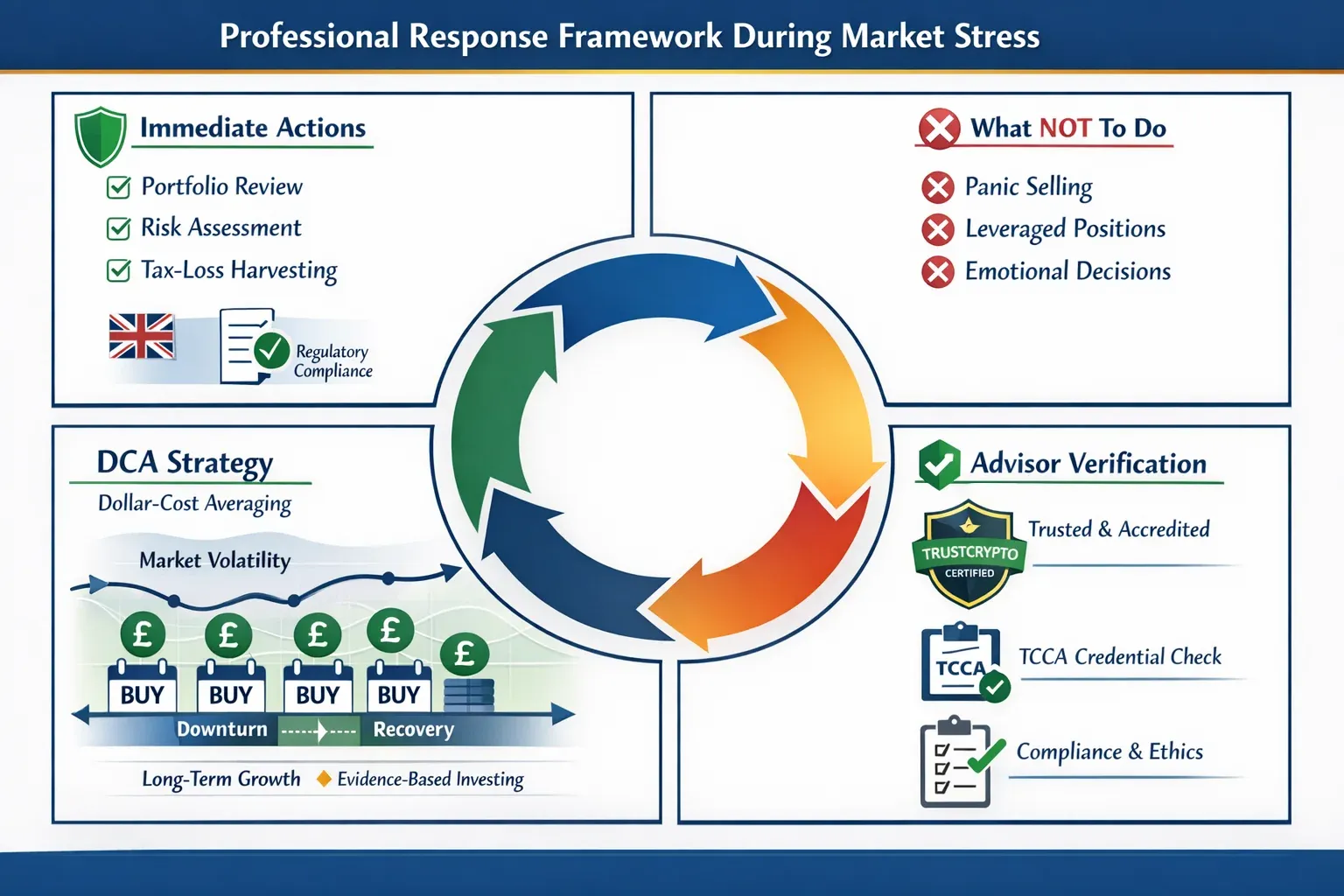
When market stress occurs, FCA-compliant advisors must immediately review client portfolios against stated risk tolerances and investment objectives. This isn't optional,it's a professional obligation under UK regulatory frameworks.
The assessment should include:
- Current allocation vs. target allocation: Has the crash caused crypto exposure to fall below strategic targets?
- Liquidity requirements: Do clients need access to capital in the near term?
- Risk capacity verification: Has the client's financial situation changed since initial allocation?
- Emotional capacity check: Is the client experiencing stress that might lead to poor decisions?
Documentation matters. Professional advisors should record portfolio reviews, client communications, and rationale for any recommended actions. This protects both client and advisor whilst maintaining transparent standards.
Tax-Loss Harvesting Considerations Under UK Rules
The February crash created significant tax-loss harvesting opportunities for UK investors, but these must be executed within HMRC guidelines.
Key considerations for UK taxpayers:
- Capital Gains Tax (CGT) applies to crypto disposals above the annual exempt amount (£3,000 for 2025/26 tax year)
- Same-day and 30-day pooling rules affect cost basis calculations
- Bed and breakfasting rules prevent immediate repurchase of identical assets
- Different cryptocurrencies are separate assets for tax purposes
A professional approach might involve:
- Harvesting losses on depreciated positions to offset other capital gains
- Waiting 30 days before repurchasing to avoid pooling rules (or purchasing a different cryptocurrency to maintain exposure)
- Documenting all transactions with timestamps, prices, and rationale
- Coordinating with the client's accountant to optimise overall tax position
Important: Tax-loss harvesting should never override investment strategy. The tax tail shouldn't wag the investment dog.
Rebalancing Protocols: When and How to Act
Systematic rebalancing during crashes requires clear frameworks established before market stress occurs. Emotional decision-making during volatility leads to poor outcomes.
A professional rebalancing framework might include:
Threshold-based rebalancing:
- Rebalance when crypto allocation deviates more than 5-10% from target
- Example: If target allocation is 5% and current allocation falls to 3%, consider rebalancing
Calendar-based rebalancing:
- Quarterly or semi-annual reviews regardless of market conditions
- Removes emotion by following predetermined schedule
Opportunity-based rebalancing:
- Deploy additional capital when technical indicators (RSI, moving averages) signal oversold conditions
- Requires predefined criteria, not subjective judgment
During the February crash, Bitcoin's RSI of 28.10 would have triggered opportunity-based rebalancing protocols for advisors using this framework. [1]
What NOT To Do: Avoiding Common Crash Mistakes
Professional conduct during market stress includes knowing what actions to avoid:
Regulatory compliance reminder: Under FCA financial promotion rules, advisors must ensure all communications are clear, fair, and not misleading,especially during market stress when clients are most vulnerable to poor decision-making.
Communication Frameworks for Client Management
Clear, evidence-based communication separates professional advisors from promoters during crashes. Clients need context, not reassurance.
Effective communication includes:
- Historical context: "Bitcoin has experienced similar drawdowns X times previously, recovering over periods ranging from Y to Z months"
- Portfolio impact: "Your crypto allocation has declined from £X to £Y, representing Z% of your total portfolio"
- No action required (if appropriate): "Based on your long-term objectives and risk tolerance established in [date], no changes are recommended"
- Action recommended (if appropriate): "Based on our rebalancing protocol, we recommend [specific action] because [evidence-based rationale]"
Avoid speculation: Don't predict bottoms, forecast recovery timelines, or suggest "this is the last chance to buy at these levels."
Long-Term Perspective: Building Cycle-Aware Strategies
Understanding Crypto Market Cycles and Halving Events
Professional crypto advisory requires understanding structural market cycles driven by Bitcoin's programmatic supply schedule. Bitcoin halving events,which reduce new supply issuance by 50% approximately every four years,have historically preceded major price rallies followed by significant corrections.
The pattern (not a guarantee) has been:
- Year 1 (Halving year): Moderate appreciation
- Year 2 (Post-halving): Major rally and new all-time highs
- Year 3: Peak, correction, and bear market
- Year 4: Accumulation and recovery
The October 2025 peak and February 2026 crash align with historical post-halving patterns, occurring roughly 12-18 months after the April 2024 halving. Cycle-aware strategies incorporate this structural context into portfolio construction and rebalancing decisions.
Portfolio Construction for Volatility Resilience
Evidence-based portfolio construction for crypto exposure includes:
Allocation sizing:
- Most professional frameworks recommend 1-5% crypto allocation for balanced portfolios
- Higher allocations (5-10%) only for investors with high risk capacity and tolerance
- Institutional investors may use 0.5-2% allocations
Diversification within crypto:
- Bitcoin as primary holding (60-80% of crypto allocation)
- Ethereum as secondary (15-30% of crypto allocation)
- Selective altcoin exposure (0-10%) only with clear investment thesis
Rebalancing discipline:
- Systematic protocols prevent emotional decision-making
- Tax-efficient implementation considering UK rules
- Documentation of all decisions and rationale
The Role of Professional Standards During Market Stress
Market crashes reveal which advisors maintain professional standards and which prioritise short-term client retention over long-term fiduciary duty.
TrustCrypto Institute's framework emphasises:
- Competence: Understanding market structure, regulatory requirements, and technical analysis
- Ethics: Putting client interests first, even when difficult conversations are required
- Transparency: Clear disclosure of risks, limitations, and potential conflicts
- Accountability: Documentation, ongoing education, and adherence to published standards
TCCA-certified advisors are assessed on their ability to navigate market stress professionally, including:
- Risk disclosure protocols
- Portfolio review procedures
- Client communication frameworks
- Regulatory compliance during volatile periods
The February 2026 crash serves as a case study in professional conduct. Advisors who maintained systematic approaches, communicated clearly, and avoided emotional decision-making protected both their clients and their professional reputations.
Regulatory Context: FCA Guidance and Consumer Protection
Current UK Regulatory Framework for Crypto Advisory
The Financial Conduct Authority (FCA) has established clear frameworks for crypto-related financial services, though the regulatory landscape continues to evolve.
Key regulatory points for 2026:
- Crypto asset promotions fall under FCA financial promotion rules as of October 2023
- Only FCA-authorised firms may approve or communicate financial promotions for crypto
- Risk warnings are mandatory in all crypto-related financial promotions
- Appropriateness assessments required before allowing retail clients to access crypto
For professional advisors, this means:
- All client communications must comply with financial promotion rules
- Risk disclosures must be prominent and clear
- Client suitability must be documented
- Ongoing monitoring and review protocols must be maintained
Professional Accountability and Verification
The crypto advisory industry faces a credibility crisis exacerbated by market crashes. When prices decline sharply, clients question whether their advisors possessed genuine expertise or merely benefited from a rising market.
Professional certification provides verification of baseline competence and ethical standards. The TCCA (TrustCrypto Certified Advisor) credential demonstrates:
- Knowledge competence: Assessed understanding of crypto technology, markets, and regulation
- Regulatory awareness: Understanding of UK-specific FCA guidance and HMRC rules
- Professional conduct: Commitment to published ethical standards
- Continuing education: Ongoing professional development requirements
During market stress, verified credentials matter. Clients seeking trustworthy advice can verify advisor qualifications through public registries, ensuring they work with professionals who meet transparent standards rather than self-proclaimed experts.
Conclusion: Building Trust Through Market Cycles
The February 2026 crypto crash demonstrated that institutional participation doesn't eliminate volatility, regulatory uncertainty remains a persistent headwind, and structural market forces can overwhelm short-term sentiment. Bitcoin's 43% decline from all-time highs, accompanied by £2 billion in daily liquidations and £14 billion in stablecoin outflows, revealed the fragility of assumptions about permanent institutional support. [1] [2]
For professional advisors, crashes provide opportunities to demonstrate value through systematic frameworks, clear communication, and evidence-based decision-making. The advisors who maintained discipline,reviewing portfolios against stated objectives, considering tax-loss harvesting within UK rules, and avoiding emotional reactions,protected both client outcomes and professional reputations.
Actionable next steps for professionals:
- Review and document portfolio allocation protocols before the next market stress event
- Establish clear rebalancing frameworks with predetermined triggers and criteria
- Verify professional credentials through assessment-led certification (TCCA for advisors, TCCS for compliance specialists)
- Maintain continuing education on regulatory developments, market structure, and technical analysis
- Build client communication frameworks that provide context without speculation
For investors seeking qualified advisors:
- Verify credentials through TrustCrypto's public registry of certified professionals
- Ask about systematic frameworks for portfolio management during volatility
- Request documentation of advisory processes and rebalancing protocols
- Confirm regulatory compliance with FCA financial promotion rules
- Prioritise substance over speculation when evaluating advisor recommendations
The crypto market will experience future crashes,this is certain. What remains uncertain is whether participants will learn from February 2026's lessons about institutional behaviour, structural market dynamics, and the critical importance of professional standards. Raising the baseline for crypto advisory competence isn't merely an industry aspiration. it's a consumer protection imperative.
Market cycles separate credible professionals from opportunistic promoters. Standards matter, especially when prices don't.
Author: TrustCrypto Editorial Team
The TrustCrypto Editorial Team consists of certified crypto advisors and tax professionals with extensive experience in UK cryptocurrency regulation and compliance.
Take the Next Step
Ready to advance your crypto expertise? Explore our TCCS certification to enhance your professional credentials.
References
- [1] Crypto Crash Bitcoin Prices - https://money.com/crypto-crash-bitcoin-prices/
- [2] Bitcoin 3 Numbers Behind The 70k Crashand Why It Blindsided Everyone 200674531 - https://www.investing.com/analysis/bitcoin-3-numbers-behind-the-70k-crashand-why-it-blindsided-everyone-200674531