
In 2026, decentralised autonomous organisations (DAOs) manage billions of pounds in treasury assets, direct protocol development, and shape the future of digital finance,yet many are struggling to govern themselves effectively. If you work in financial advisory, compliance, or institutional crypto investment, understanding how these structures operate (and where they fail) is no longer optional. Learn more with our crypto tax calculator. DAO governance explained: decentralised decision making is a topic that sits at the intersection of technology, law, and professional accountability, and it demands serious, evidence-based analysis rather than hype. Explore more in our Web3 section.
At TrustCrypto Institute, we approach emerging crypto structures with the same rigour we bring to our assessment-led certification programmes. DAOs represent one of the most ambitious experiments in organisational design since the joint-stock company,but ambition without clear frameworks leads to confusion, liability, and loss. This guide unpacks how DAO governance works in practice, where it is evolving, and what professionals need to know to advise clients or manage risk responsibly.
What Is a DAO? Foundations of Decentralised Decision Making
A decentralised autonomous organisation (DAO) is an entity governed by rules encoded in smart contracts on a blockchain, where decision-making authority is distributed among token holders rather than concentrated in a board of directors or executive team. In theory, this creates a transparent, permissionless governance structure where anyone holding governance tokens can propose changes, vote on treasury allocations, and shape strategic direction.
The core components of most DAOs include:
At their best, DAOs embody principles of transparency, collective ownership, and accountability. Every vote is recorded on-chain. Every treasury movement is auditable. Every governance token holder has a voice.
But as we will explore, the gap between this ideal and operational reality has widened considerably. Understanding DAO governance explained through the lens of decentralised decision making requires examining not just the theory, but the messy, evolving practice.
> For advisory professionals: If a client holds governance tokens or has capital deployed in a DAO-governed protocol, you need to understand the governance risks as thoroughly as you understand market risk. Standards matter here,perhaps more than anywhere else in crypto.
How DAO Governance Works in Practice: Mechanisms and Models
The Standard Governance Lifecycle
Most DAO governance follows a recognisable pattern:
- Discussion , A community member raises an idea on a governance forum (e.g., Discourse, Commonwealth).
- Temperature check , An informal poll gauges sentiment before a formal proposal.
- Formal proposal , The idea is codified with specific parameters (budget, timeline, technical specifications).
- Voting period , Token holders vote on-chain, typically over 3–7 days.
- Execution , If the proposal passes quorum and threshold requirements, smart contracts execute the decision automatically.
This process sounds elegant. In practice, it encounters significant friction.
Voting Models
DAOs employ several voting mechanisms, each with trade-offs:
- Token-weighted voting , One token, one vote. Simple but favours large holders ("whales").
- Quadratic voting , Voting power scales with the square root of tokens committed, reducing whale dominance.
- Conviction voting , Preferences strengthen over time, rewarding sustained commitment.
- Delegated voting , Token holders assign their voting power to a trusted representative.
- Optimistic governance , Proposals pass unless actively vetoed within a set timeframe.
Understanding these models is essential for anyone advising on protocol risk or evaluating the governance quality of a DeFi investment. A protocol using pure token-weighted voting with concentrated ownership presents fundamentally different risks than one employing quadratic voting with active delegation.
DAO Governance Explained: Decentralised Decision Making Hits Its Limits in 2026
The Scaling Problem
By 2026, the DAO governance experiment has produced enough data to draw meaningful conclusions,and many of them are sobering. Multiple major protocols have acknowledged that their governance processes simply do not scale efficiently [3]. Full-community votes have proven "too noisy for technical nuances," with voting often too slow for operational needs and vulnerable when applied to security-sensitive decisions [3].
Consider the practical reality: a protocol facing a critical smart contract vulnerability cannot wait five days for a governance vote to authorise a patch. A treasury needing to rebalance in response to market conditions cannot convene thousands of token holders for every allocation decision.
Declining Participation and Whale Dominance
Voter participation rates dropped significantly across major DAOs in 2025 and into 2026 [3]. Even Arbitrum and Uniswap,which maintained the highest participation levels,experienced decreases in voter numbers [3]. The reasons are structural:
- Lack of incentives , Voting costs time and gas fees but offers no direct financial reward [2].
- Governance fatigue , Token holders face dozens of proposals across multiple protocols.
- Complexity , Many proposals require deep technical or financial knowledge to evaluate meaningfully.
- Whale concentration , Some DAOs saw voting effectively taken over by large holders pushing specific outcomes, discouraging smaller participants [2] [3].
This creates a paradox: governance structures designed to distribute power end up concentrating it among a small number of engaged (and often wealthy) participants.
> 📊 By the numbers: One active delegate reported casting 725 votes across 18 protocols with over 8 million in voting power,illustrating just how professionalised and concentrated governance participation has become [3].
Governance Pauses and Restructuring
The strain has led several protocols to take dramatic action:
- Centrifuge paused active DAO governance entirely through Proposal CP171 in late 2025, transferring execution authority to the Centrifuge Network Foundation for faster decision-making [1].
- Jupiter paused governance for six months to reassess its processes and incentive structures [2].
- Arbitrum introduced an Operating Company (OpCo) structure to handle day-to-day execution [2].
- Uniswap concentrated authority into its DUNI framework [2].
These are not minor adjustments. They represent a fundamental rethinking of what decentralised governance means in practice.
The Hybrid Governance Revolution: DAO Governance Explained for the Next Era of Decentralised Decision Making
From Pure Democracy to Structured Delegation
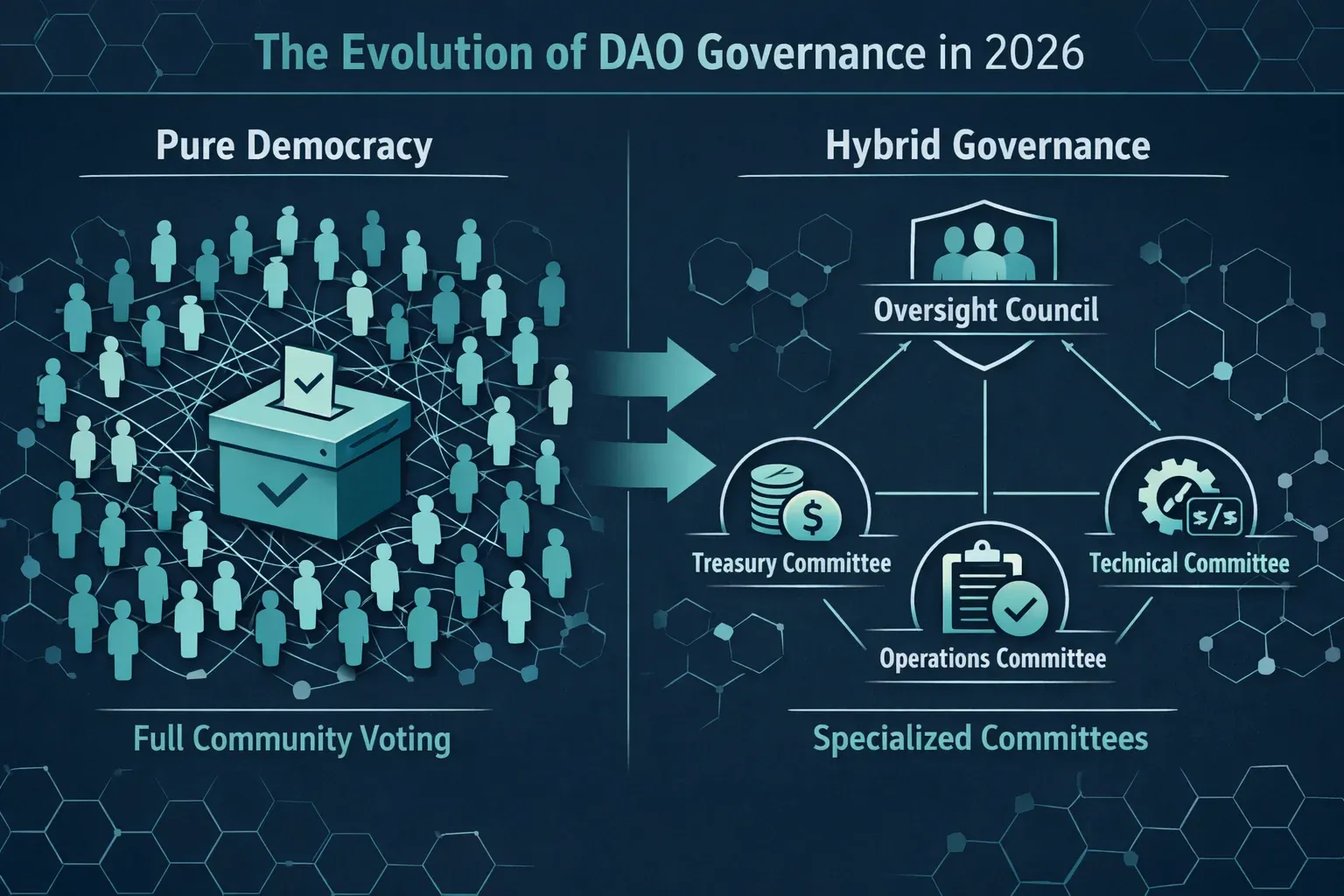
The most significant trend in DAO governance in 2026 is the shift toward hybrid operational models that combine specialised execution teams with broader community oversight [2] [3]. Rather than asking every token holder to vote on every decision, protocols are developing clear frameworks that distinguish between different types of decisions:
This separation acknowledges a practical truth: not every decision benefits from mass participation, but critical decisions about direction, values, and resource allocation absolutely require broad input.
Professional Delegation
Token holders are increasingly delegating their voting power to full-time professional delegates as governance complexity grows [3]. These delegates:
- Dedicate significant time to understanding proposals across multiple protocols
- Develop specialised expertise in areas like treasury management, technical architecture, or legal compliance
- Provide accountability through public voting records and rationale statements
- Operate as a professional class within the DAO ecosystem
This professionalisation mirrors developments in traditional corporate governance, where institutional investors delegate proxy voting to specialist firms. It raises important questions about accountability, conflicts of interest, and the meaning of "decentralisation" when a small group of professionals wields outsized influence.
Specialised Committees
DAOs are also establishing expert committees for specific oversight functions. Centrifuge, for example, created a Treasury Advisory Group to oversee financial risk and transparency [1]. Other protocols have formed security councils, grants committees, and legal working groups.
For compliance and risk professionals, this evolution is significant. It suggests that DAOs are,sometimes reluctantly,converging toward governance structures that resemble traditional corporate boards, albeit with greater transparency and on-chain accountability.
Legal Risks and Regulatory Reality: What Professionals Must Understand
The Liability Question
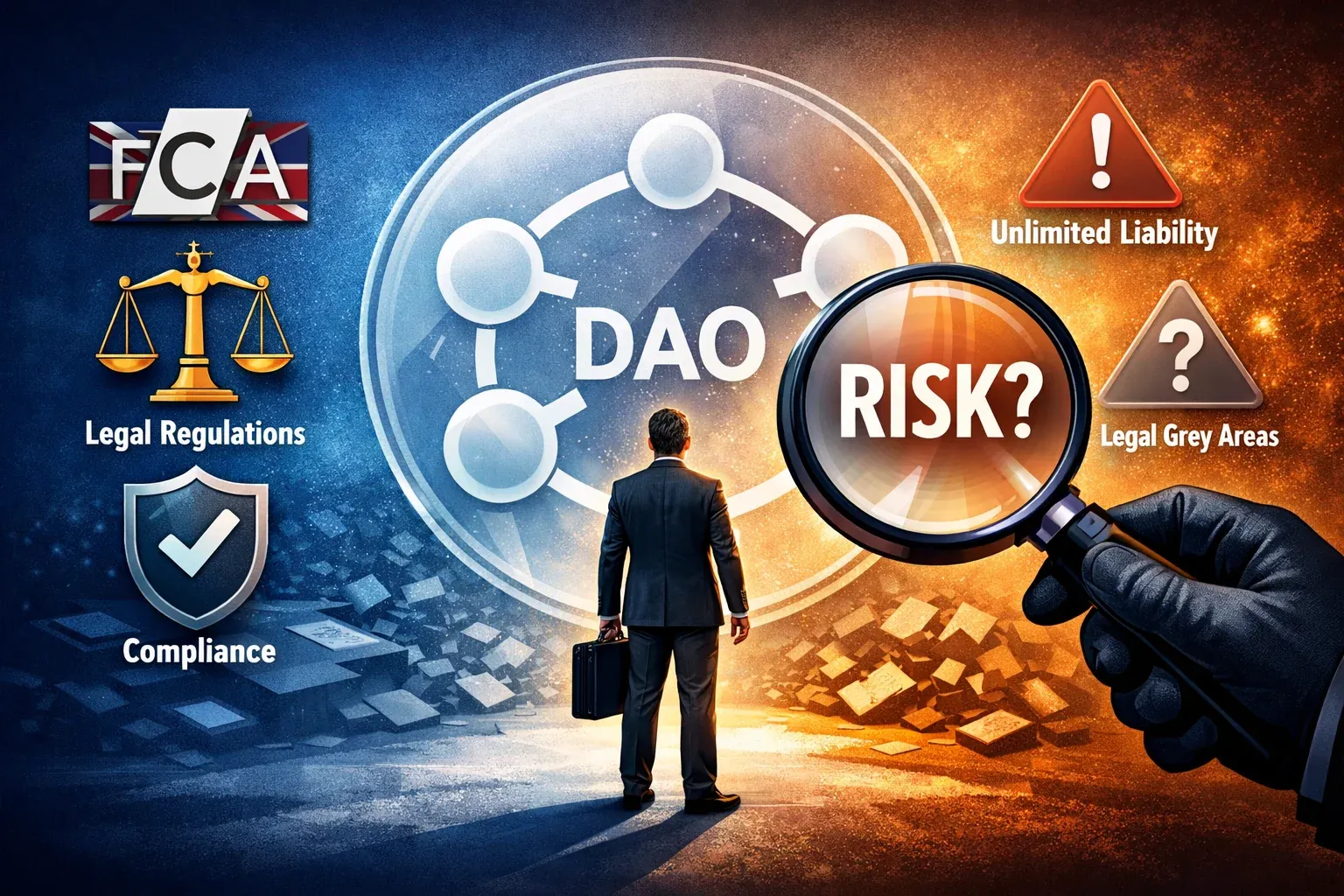
Perhaps the most critical issue for anyone advising on or participating in DAOs is personal liability. High-profile enforcement actions have demonstrated that regulators and courts are willing to pursue unstructured DAOs through partnership law.
The Ooki DAO enforcement action and the Samuels v. Lido DAO case established that all members of an unstructured DAO,including venture capital firms,could face unlimited personal liability for organisational obligations [1]. This is not theoretical risk. It is established legal precedent.
> ⚠️ Critical compliance point: If your client holds governance tokens in an unstructured DAO, they may be legally classified as a general partner with unlimited personal liability. This risk must be disclosed clearly and documented thoroughly.
The Legal Grey Zone
Despite proposals for DAO-specific legal structures in jurisdictions like Wyoming (USA) and Zug (Switzerland), most DAOs remain in a legal grey area [2] [3]. Key uncertainties include:
- Protocol ownership , Who actually "owns" a DAO-governed protocol?
- Brand rights , Can a DAO control its brand, or does the development team?
- Profit distribution , How are revenues allocated between the DAO treasury, token holders, and core contributors?
- Employment relationships , Are DAO contributors employees, contractors, or something else entirely?
The Aave DAO vs. Aave Labs dispute brought these questions into sharp focus. Approximately £8 million annually in CoW Swap integration fees were flowing to Aave Labs rather than the DAO, while a vote on brand ownership failed,raising fundamental questions about what "DAO-owned" actually means when core teams control development [3].
UK Regulatory Context
For UK-based professionals, the regulatory landscape adds further complexity. The FCA's evolving approach to crypto regulation, including the Financial Promotion Rules, applies to communications about DAO-governed protocols. HMRC's treatment of governance token rewards, staking income, and treasury distributions requires careful analysis.
Professionals pursuing TrustCrypto Institute's certification pathways,whether the TCCA (TrustCrypto Certified Advisor) or TCCS (TrustCrypto Certified Specialist),study these governance structures as part of our rigorous assessment process. Understanding DAO governance is not an academic exercise. it is a core competency for anyone operating in the UK crypto advisory space.
The SEC's dismissal of proceedings against American CryptoFed DAO LLC on 4 February 2026 [8] demonstrates that regulatory approaches remain in flux globally. A compliance-first approach, grounded in evidence-based analysis rather than assumptions, is essential.
Practical Frameworks for Evaluating DAO Governance
Whether you are advising a client, assessing a protocol for investment, or managing compliance risk, a structured methodology for evaluating DAO governance quality is invaluable. We recommend assessing the following dimensions:
DAO Governance Evaluation Checklist ✅
- Legal structure , Is the DAO wrapped in a legal entity (foundation, LLC, association)? If not, what liability exposure exists?
- Decision-type separation , Does the DAO distinguish between operational, strategic, and constitutional decisions?
- Voter participation , What are actual participation rates? Are they trending up or down?
- Power concentration , How concentrated is voting power? What is the Nakamoto coefficient for governance?
- Delegate accountability , Are delegates publicly identified? Do they publish voting rationale?
- Treasury oversight , Is there a specialised committee or advisory group overseeing treasury management?
- Conflict of interest policies , Are there transparent disclosures for delegates and core contributors?
- Emergency procedures , Can the DAO respond quickly to security threats without full community votes?
- Legal compliance , Is the DAO compliant with relevant jurisdictional requirements, including UK FCA guidance?
- Audit and transparency , Are financial reports published regularly? Are smart contracts audited?
This checklist provides a starting point. For professionals seeking deeper competence, TrustCrypto Institute's continuing education and CPD requirements ensure that certified advisors maintain current knowledge of governance developments.
The Future of DAO Governance: What Comes Next?
Vitalik Buterin has been actively pushing new DAO models for courts, oracles, and governance structures [5], and academic researchers are mapping DAO governance across chains to build comprehensive datasets [6]. The direction of travel is clear:
- Greater professionalisation of governance roles, with accountability mechanisms
- Clearer legal frameworks, though progress will be uneven across jurisdictions
- Hybrid models becoming the default rather than the exception
- Improved tooling for delegation, voting, and treasury management
- Regulatory convergence as bodies like the FCA develop more specific guidance
For UK professionals, this evolution presents both opportunity and responsibility. The crypto advisory market needs qualified professionals who can navigate these complexities with competence and ethics. Credibility over hype, substance over speculation,these principles are not just slogans. They are the foundation of trustworthy advice in a rapidly evolving landscape.
Conclusion: Building Professional Competence in DAO Governance
DAO governance represents one of the most fascinating,and challenging,experiments in organisational design of our era. The shift from pure community voting to hybrid models, the rise of professional delegates, and the growing clarity around legal risks all point toward a maturing ecosystem that increasingly resembles (while remaining distinct from) traditional governance structures.
Here are your actionable next steps:
- 📚 Educate yourself deeply , Move beyond surface-level understanding. Study specific DAO constitutions, voting records, and treasury reports.
- ⚖️ Assess liability exposure , For any client holding governance tokens, conduct a thorough legal risk assessment, particularly regarding unstructured DAOs.
- 🔍 Use structured evaluation frameworks , Apply the checklist above (or develop your own) to systematically assess governance quality.
- 🎓 Pursue recognised credentials , TrustCrypto Institute's certification pathways provide rigorous, assessment-led training in crypto governance, compliance, and advisory standards. Our professional development programmes are designed for exactly this kind of complexity.
- 📰 Stay current , DAO governance is evolving rapidly. Commit to continuing education and engage with published frameworks from independent standards bodies.
The professionals who invest in understanding DAO governance now,with a long-term perspective, a compliance-first mindset, and genuine commitment to raising the baseline of crypto advisory quality,will be the ones clients and institutions trust when the stakes are highest.
Standards matter. Verified credentials matter. And in the world of DAO governance, knowledge-first is the only responsible approach.
Related Resources
Explore these helpful tools and guides:
Take the Next Step
Ready to advance your crypto expertise? Explore our professional certification programmes to enhance your credentials.
References
- [1] Hot Topics In International Trade 2682435 - https://www.jdsupra.com/legalnews/hot-topics-in-international-trade-2682435/
- [2] mexc - https://www.mexc.com/en-NG/news/571799
- [3] Its 2026 Already Daos Should Have Matured By Now Hlgmu38k - https://www.htx.com/news/its-2026-already-daos-should-have-matured-by-now-hLGmu38k/
- [5] C18a5 Vitalik Buterin Pushes New Dao Models For Courts Oracles Governance - https://cryptorank.io/news/feed/c18a5-vitalik-buterin-pushes-new-dao-models-for-courts-oracles-governance
- [6] Mapping Decentralized Autonomous Organization Governance Across Chains An Updated M - https://2026.msrconf.org/details/msr-2026-data-and-tool-showcase-track/11/Mapping-Decentralized-Autonomous-Organization-Governance-Across-Chains-An-Updated-M
- [8] Crypto Brief February 5 2026 - https://www.lowenstein.com/news-insights/newsletters/crypto-brief-february-5-2026