
The metaverse is no longer a speculative concept confined to science fiction. It is a rapidly maturing ecosystem where real capital flows into virtual land, digital assets, and the infrastructure that underpins immersive online worlds. With the metaverse market reaching USD 52.1 billion in 2022 and projections pointing toward USD 1,020.6 billion by 2030 , a compound annual growth rate of 45.5% [3] , the question for serious investors and advisory professionals is no longer whether to pay attention, but how to approach metaverse investment opportunities: virtual land to digital assets with rigour, discipline, and a clear-eyed understanding of risk. Explore more in our Web3 section.
At TrustCrypto Institute, we believe in substance over speculation. This guide is designed for financial professionals, compliance officers, and serious investors who want a structured methodology for evaluating metaverse investments , grounded in evidence, aligned with UK regulatory expectations, and built for the long term.
Understanding Metaverse Investment Opportunities: Virtual Land to Digital Assets
Before committing capital, it is essential to understand what the metaverse actually represents as an investment landscape. The term "metaverse" describes persistent, interconnected virtual environments where users can socialise, work, create, and transact using digital assets. These environments are increasingly underpinned by blockchain technology, which provides verifiable ownership and programmable scarcity.
The Three Core Investment Categories
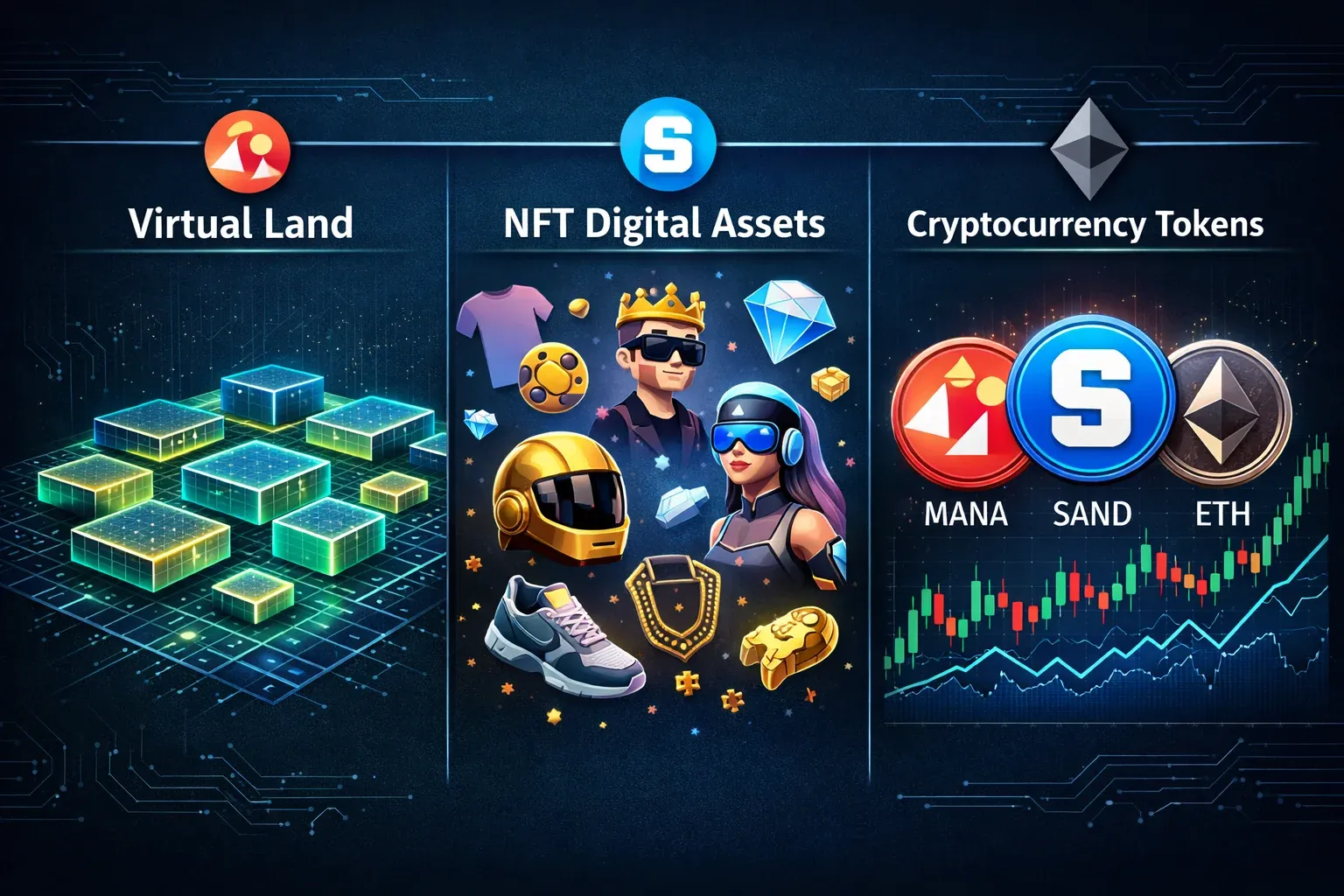
According to established frameworks, metaverse investment opportunities: virtual land to digital assets can be grouped into three primary categories [2]:
Each category carries distinct risk-reward profiles, liquidity characteristics, and regulatory considerations. A cycle-aware strategy demands that investors understand these differences before allocating capital.
Virtual Land: Digital Real Estate Explained
Virtual land refers to parcels of digital real estate within blockchain-based metaverse platforms. Ownership is recorded on-chain, typically on Ethereum, and represented as NFTs. The primary platforms include Decentraland and The Sandbox, both built on Ethereum and offering native tokens alongside NFT-based in-game assets [2].
The investment thesis for virtual land rests on several assumptions:
- Scarcity: Most platforms cap the total number of available parcels
- Location value: Proximity to high-traffic areas or branded experiences commands premiums
- Development potential: Landowners can build experiences, host events, or lease their parcels
- Network effects: As user adoption grows, demand for prime locations may increase
In January 2026, Yuga Labs launched its Otherside metaverse platform, featuring The Swamp social world, Nexus hub, and community games including Bathroom Blitz and Otherside Outbreak , all designed around NFT-driven virtual experiences [3]. This represents one of the most significant platform launches in the space and illustrates how major players are building ecosystems around virtual land ownership.
> ⚠️ Professional Note: Virtual land valuations are highly speculative and depend entirely on platform adoption. Unlike physical property, virtual land has no intrinsic utility outside its platform. If a platform loses users, land values can collapse to near zero. This is not comparable to traditional real estate investment.
NFTs and Digital Assets
Non-fungible tokens extend beyond virtual land to encompass avatars, digital wearables, artwork, music, and in-game items. These assets derive value from their utility within specific platforms, their cultural significance, or their scarcity.
The NFT market has matured considerably since its 2021 peak, with greater emphasis on utility-driven assets rather than purely speculative collectibles. Gaming accounts for 40% of metaverse applications [3], and play-to-earn models continue to drive demand for in-game NFTs.
Metaverse Cryptocurrencies
Native tokens like MANA and SAND serve as the medium of exchange within their respective platforms. They are used to purchase land, pay for services, and participate in governance. In October 2025, Coincheck initiated an Initial Exchange Offering (IEO) for Fanpla (FPL) cryptocurrency to power the Fanpla ecosystem and accelerate metaverse transactions in Japan [3], illustrating the continued expansion of metaverse-linked token economies.
Indirect Exposure: Equities and ETFs
Not every investor wants , or should want , direct exposure to volatile blockchain-based assets. Several indirect routes exist for gaining exposure to metaverse growth themes.
Metaverse Stocks
Corporate investment in metaverse infrastructure continues to accelerate. Microsoft has advanced Mesh for Teams and HoloLens integrations within Azure cloud, Epic Games enhanced Unreal Engine 5.4 with photorealistic capabilities, and Unity Technologies introduced Unity 6 with AI runtime for developer monetisation [3].
MarketBeat identified several metaverse-related stocks with significant recent trading volume, including Everbright Digital (EDHL), Global Mofy AI (GMM), HUB Cyber Security (HUBCW), and Robot Consulting (LAWR) , though it is worth noting that Everbright Digital currently carries a Sell rating among analysts [1].
> 💡 Key Principle: High trading volume does not equal investment quality. Credibility over hype demands that professionals conduct thorough fundamental analysis before recommending any metaverse equity.
ETF Exposure
For those seeking diversified exposure, the ProShares Metaverse ETF (VERS), launched in March 2022, offers a basket of metaverse-adjacent companies including Roblox (RBLX), Apple (AAPL), NVIDIA (NVDA), and Microsoft (MSFT). Over 90% of its holdings are US-based companies [2].
This approach provides:
- ✅ Diversification across multiple companies and sub-sectors
- ✅ Regulated investment vehicle familiar to traditional portfolios
- ✅ Lower volatility compared to direct crypto/NFT exposure
- ✅ Easier tax treatment under standard UK capital gains rules
Market Dynamics and Regional Growth in 2026
Understanding the macroeconomic context is critical for any evidence-based approach to metaverse investing. Learn more with our crypto tax calculator.
Global Market Trajectory
The metaverse market's projected growth from USD 52.1 billion (2022) to USD 1,020.6 billion by 2030 represents one of the most aggressive growth curves in technology [3]. North America currently holds the largest market share at 44.6%, whilst Asia Pacific is the fastest-growing region at over 40% CAGR through 2035, driven by smartphone penetration and gaming booms in China and Japan [3].
Metaplanet launched US and Japan subsidiaries in September 2025, targeting the projected £640 billion market opportunity by 2030 (approximately USD 800 billion) through cross-border virtual platform development [3].
The Meta Pivot: A Cautionary Signal
Perhaps the most significant strategic shift in 2026 is Meta's decision to redirect focus away from the metaverse toward AI devices, doubling the output of its Ray-Ban AI-glasses rather than prioritising traditional metaverse development [4]. This pivot by the company that literally renamed itself after the metaverse concept should give investors pause.
What does this mean for the investment thesis?
- Platform risk is real: Even the largest players can change direction
- The metaverse may evolve differently than initially envisioned , more AR-integrated than fully immersive VR
- Diversification matters: Concentration in any single platform or vision of the metaverse is imprudent
> "Meta's strategic pivot underscores why a long-term perspective and diversified approach are essential. The metaverse is not a single company's product , it is an evolving ecosystem."
Risk Framework: Evaluating Metaverse Investment Opportunities from Virtual Land to Digital Assets
At TrustCrypto Institute, we believe that standards matter and that risk disclosure is not optional , it is foundational to ethical advisory practice. Here is our framework for evaluating metaverse investments.
Key Risk Categories
- Platform Risk 🔴 , Virtual land and NFTs are entirely dependent on the continued operation and popularity of their host platform. If Decentraland shuts down, your land ceases to exist.
- Liquidity Risk 🟠 , Many metaverse assets trade in thin markets. Selling a virtual land parcel at fair value can take weeks or months, if it sells at all.
- Regulatory Risk 🟡 , The FCA's evolving stance on cryptoassets, including the Financial Promotion Rules introduced in 2023, directly affects how metaverse investments can be marketed and sold in the UK. Advisors must ensure FCA-compliant practices.
- Valuation Risk 🔴 , There are no established valuation methodologies for virtual land comparable to discounted cash flow or comparable sales analysis in traditional property. Pricing is largely sentiment-driven.
- Technology Risk 🟠 , Smart contract vulnerabilities, blockchain congestion, and interoperability challenges can affect asset value and accessibility.
- Tax Complexity 🟡 , HMRC treats cryptoassets (including NFTs) as property for capital gains tax purposes. Virtual land transactions, staking rewards, and token swaps all carry potential tax obligations that require careful documentation.
Due Diligence Checklist for Professionals
Before recommending or investing in any metaverse asset, qualified professionals should verify:
- Platform fundamentals: Active user count, developer activity, funding runway
- Token economics: Supply schedule, inflation rate, governance mechanisms
- Regulatory status: Is the asset classified as a security, utility token, or unregulated asset under UK law?
- Liquidity profile: Average daily trading volume, bid-ask spreads, marketplace depth
- Smart contract audits: Has the underlying code been independently audited?
- Team and governance: Who controls the platform? Is governance decentralised or centralised?
- Tax implications: Capital gains, income tax on yield, VAT considerations
This structured methodology reflects the kind of rigorous assessment that TrustCrypto Institute embeds in its certification pathways, including the TCCA (TrustCrypto Certified Advisor) and TCCS (TrustCrypto Certified Specialist) programmes.
Building a Metaverse Allocation: Practical Considerations
For investors considering exposure to metaverse assets, here are practical guidelines grounded in professional conduct and consumer protection principles.
Portfolio Allocation Guidance
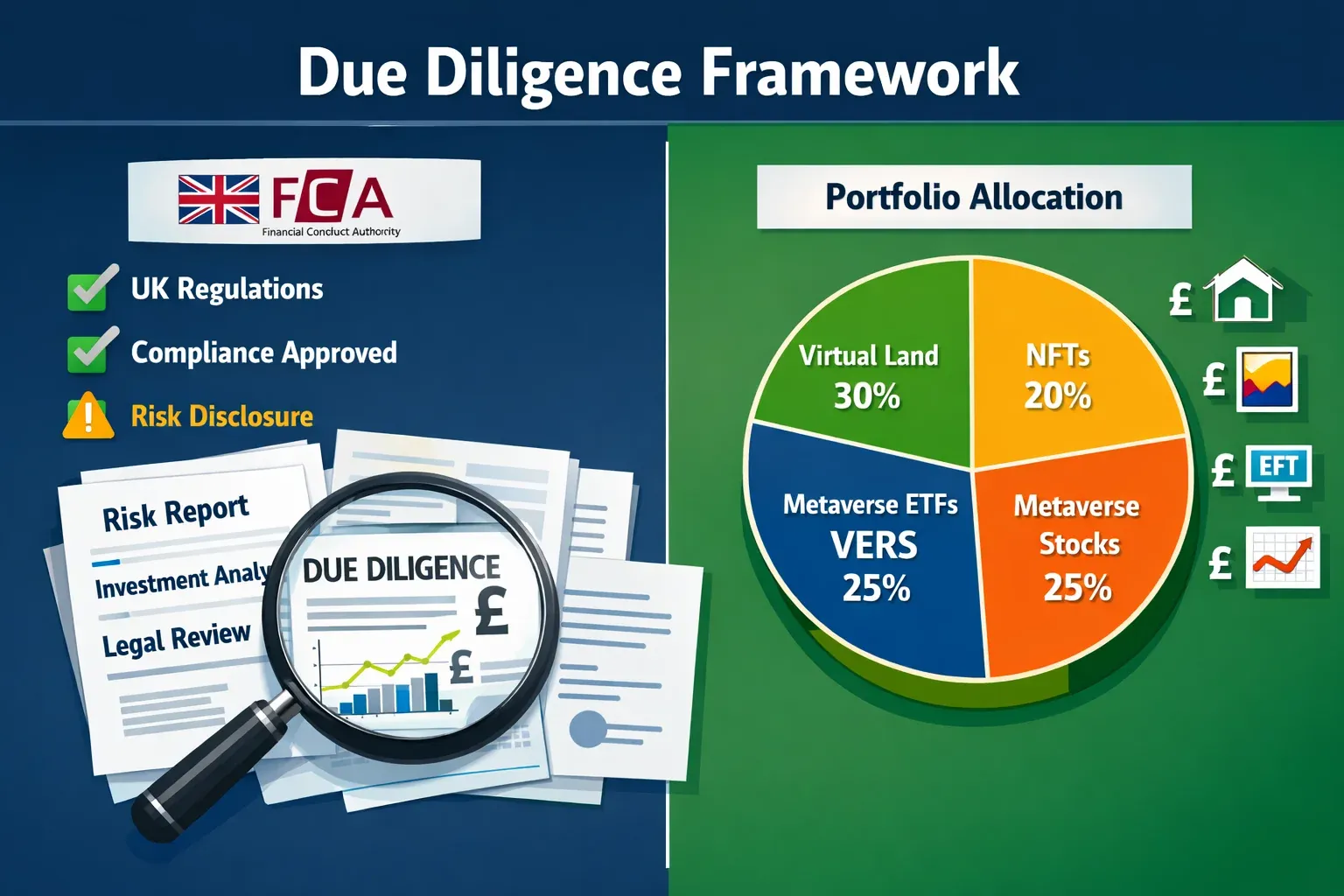
Most institutional frameworks suggest limiting speculative digital asset exposure to 5–10% of total portfolio value, depending on risk tolerance, investment horizon, and overall financial position. Within that allocation, diversification across asset types is prudent:
> ⚠️ Risk Disclosure: Past performance in metaverse assets is not indicative of future results. Many virtual land parcels and NFTs have lost 80-95% of their peak values. Only invest what you can afford to lose entirely.
The Role of Professional Standards
As the metaverse investment landscape matures, the need for qualified professionals with verified credentials becomes increasingly important. Investors seeking exposure to these assets should work with advisors who demonstrate:
- Assessment-led certification in digital assets
- Understanding of UK crypto regulation and FCA requirements
- A compliance-first approach to financial promotions
- Transparent disclosures about risks, fees, and conflicts of interest
- Continuing education and CPD requirements to stay current
TrustCrypto Institute exists precisely to raise the baseline for professional conduct in this space. Our published frameworks and independent standards body approach ensure that advisors recommending metaverse investments have demonstrated genuine competence , not just enthusiasm.
Conclusion: A Measured Approach to an Evolving Opportunity
Metaverse investment opportunities: virtual land to digital assets represent a genuinely novel asset class with significant growth potential. The projected trajectory toward a trillion-dollar market by 2030 [3] is compelling. The breadth of investment vehicles , from direct NFT purchases to regulated ETFs , provides multiple entry points for different risk appetites.
However, this is not a space for the undisciplined. Market cycles will test conviction. Platform risks will materialise. Regulatory frameworks will tighten. And many of today's metaverse projects will not survive to 2030.
Actionable Next Steps
- Educate first, invest second. Build genuine understanding of blockchain technology, NFT mechanics, and metaverse economics before committing capital. A knowledge-first approach protects against costly mistakes.
- Start with indirect exposure. ETFs like ProShares VERS [2] offer diversified, regulated access to metaverse growth themes without the complexity of wallet management and smart contract interaction.
- Apply rigorous due diligence. Use the checklist above for any direct investment. If you cannot answer every question, you are not ready to invest.
- Work with qualified advisors. Seek professionals with verified credentials and a demonstrable understanding of both the opportunities and the risks. TrustCrypto Institute's certified advisor directory can help.
- Maintain a long-term perspective. The metaverse is a decade-long thesis, not a quarter-long trade. Size positions accordingly and prepare for significant volatility.
The metaverse may well reshape how we work, socialise, and transact. But trust and consistency in how we approach these investments , through clear frameworks, professional accountability, and an unwavering commitment to competence and ethics , will determine whether investors capture the opportunity or become casualties of the hype cycle.
Standards matter. Especially when the territory is new. 🌐
Related Resources
Explore these helpful tools and guides:
Take the Next Step
Ready to advance your crypto expertise? Explore our professional certification programmes to enhance your credentials.
References
- [1] Best Metaverse Stocks Worth Watching February 10th 2026 02 10 - https://www.marketbeat.com/instant-alerts/best-metaverse-stocks-worth-watching-february-10th-2026-02-10/
- [2] Metaverse Investment - https://naga.com/en/academy/metaverse-investment
- [3] Metaverse Market Set For Explosive Growth To Usd 1 020 6 Billion - https://www.openpr.com/news/4373133/metaverse-market-set-for-explosive-growth-to-usd-1-020-6-billion
- [4] Watch - https://www.youtube.com/watch?v=V-QJL_rqyc8