
When most people hear "NFT," they still picture pixelated apes selling for millions. That era is over. The NFT market has fundamentally shifted from speculation to utility, and if you're still viewing non-fungible tokens through the lens of 2021's digital art frenzy, you're missing the real story. This NFT investment guide: beyond digital art is designed for serious investors and professionals who want to understand where genuine value is forming,and where the risks remain significant. Explore more in our Web3 section.
At TrustCrypto Institute, we believe in substance over speculation. The NFT sector has shed hype and gained structure [1], and that structural shift demands a more rigorous, evidence-based approach to evaluation. Whether you're a financial adviser expanding into digital assets, a compliance professional navigating new territory, or an investor with meaningful crypto holdings, this guide provides the clear frameworks you need to assess NFT opportunities with professional discipline. Learn more with our crypto tax calculator.
The NFT Market in 2026: Dead or Just Different?
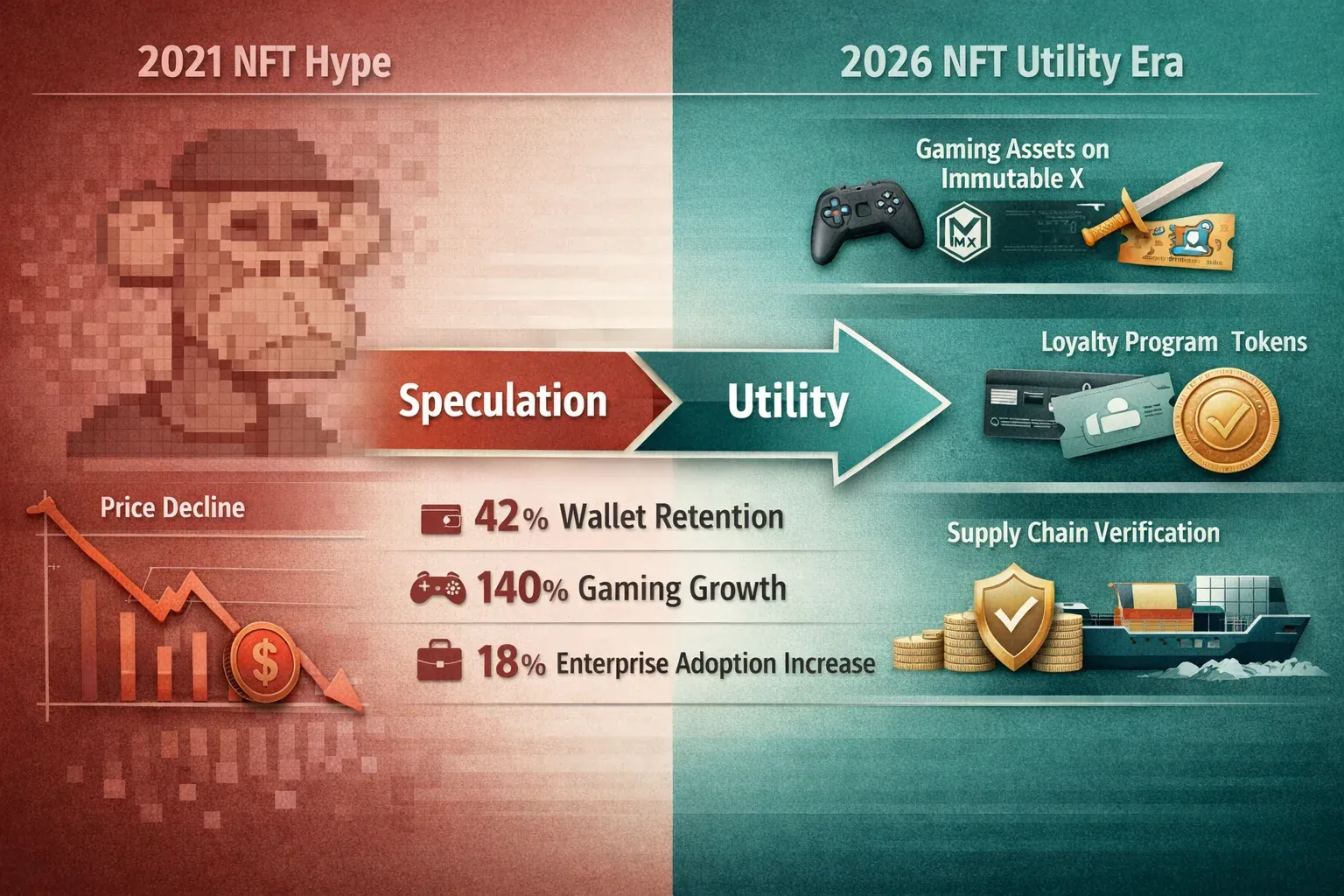
Let's address the elephant in the room. Is the NFT market dead? No. But it is profoundly different from what it was.
The global NFT industry was valued at approximately $43.08 billion (roughly £34 billion) in 2025 and is projected to reach $60.82 billion (approximately £48 billion) by end of 2026 [8]. Those are not the numbers of a dead market. However, the composition of that market has changed dramatically.
From Frenzy to Foundation
Ethereum NFT trading volume rebounded 50% from 2024 lows to approximately $720 million (£570 million) monthly in Q1 2026. That's down 79% from the 2022 peak, but it represents renewed interest grounded in utility rather than FOMO [1]. Active participation grew 80% year-over-year despite lower absolute volumes,a signal that the people who remain are building and using, not merely flipping [1].
> "The sector shed hype and gained structure." , EarnPark NFT Market Analysis, 2026 [1]
This is precisely the kind of market maturation we at TrustCrypto Institute encourage our certified professionals to recognise. Market cycles are a feature of every asset class, and the ability to distinguish between a dying market and a maturing one is a core competency for any qualified professional advising on digital assets.
The Consolidation Effect
Here's the sobering reality: 62% of 2021–2022 NFT projects are dormant or discontinued [1]. That's not a failure of the technology,it's a natural consolidation that has eliminated speculative projects whilst strengthening serious, utility-focused initiatives.
For investors, this consolidation carries a critical lesson: project selection matters enormously. The days of buying any NFT and expecting returns are gone. What remains requires the same rigorous assessment you'd apply to any early-stage venture investment.
Platform Landscape
Three platforms dominate current activity:
*Source: [1]
Understanding where activity concentrates helps investors identify liquidity,a critical factor we'll explore further below.
NFT Investment Guide: Beyond Digital Art , Where Utility Creates Value
This is the heart of our NFT investment guide: beyond digital art. If digital art was NFTs' first act, utility is its second,and it's far more interesting from an investment perspective.
🎮 Gaming: The Largest Growth Category
Gaming NFTs grew transaction counts by 140% year-over-year, with significant activity on Immutable X, Polygon, and Ronin [1]. This isn't surprising when you consider the fundamental proposition: in-game assets that players truly own, can trade, and can carry across ecosystems.
Why this matters for investors:
- Gaming creates recurring demand for NFTs (consumables, upgrades, land)
- Player engagement metrics provide measurable utility signals
- The gaming audience is orders of magnitude larger than the crypto-native art collector community
However, a word of caution from our evidence-based approach: not every gaming NFT project will succeed. The failure of projects like Dogami,which wound down after a total investment of $14 million despite initial promise,demonstrates that even well-funded gaming NFT ventures can fail [7]. Due diligence on the game's actual player base, retention metrics, and studio track record is essential.
🎫 Ticketing and Events
Enterprise NFT integrations increased 18% year-over-year, with ticketing emerging as one of the most practical applications [1]. NFT-based tickets can:
- Eliminate counterfeiting through blockchain verification
- Enable secondary market controls (artists can set resale caps or earn royalties)
- Unlock gated experiences for ticket holders before and after events
- Create collectible memorabilia with genuine provenance
For UK investors, this category is particularly noteworthy because it addresses a real consumer pain point with measurable economic impact. The UK live events industry is worth billions, and NFT ticketing represents a genuine efficiency improvement rather than a solution searching for a problem.
🏢 Supply Chain Verification
Brands are using NFTs for supply-chain verification,tracking luxury goods, pharmaceuticals, and agricultural products from origin to consumer [1]. This application leverages the core blockchain value proposition of immutable, transparent record-keeping.
🏠 Real-World Asset Tokenisation
The tokenisation of real-world assets (RWA) represents perhaps the most significant long-term opportunity adjacent to the NFT space. According to BDO's analysis of tokenisation trends, the convergence of blockchain technology with traditional asset classes is creating new investment structures that blur the line between NFTs and securities [5]. This includes:
- Fractional property ownership
- Tokenised bonds and debt instruments
- Intellectual property licensing
> ⚠️ Compliance Note: In the UK, tokenised real-world assets may constitute regulated financial instruments under FCA rules. Any professional advising clients on RWA tokens must ensure they hold appropriate permissions and provide transparent disclosures about the regulatory status of these products.
💡 Loyalty Programmes and Brand Engagement
Major brands continue experimenting with NFT-based loyalty programmes. However, there's an important caveat: NFT utility for businesses works only when customers understand crypto [1]. Adding NFT requirements can create friction for users unfamiliar with blockchain technology. The most successful implementations abstract away the blockchain complexity whilst retaining the benefits.
NFT Investment Guide: Beyond Digital Art , A Due Diligence Framework
At TrustCrypto Institute, we believe that standards matter. Whether you're investing your own capital or advising clients, a structured methodology for evaluating NFT investments is essential. Here is our recommended framework.
The TrustCrypto NFT Assessment Matrix
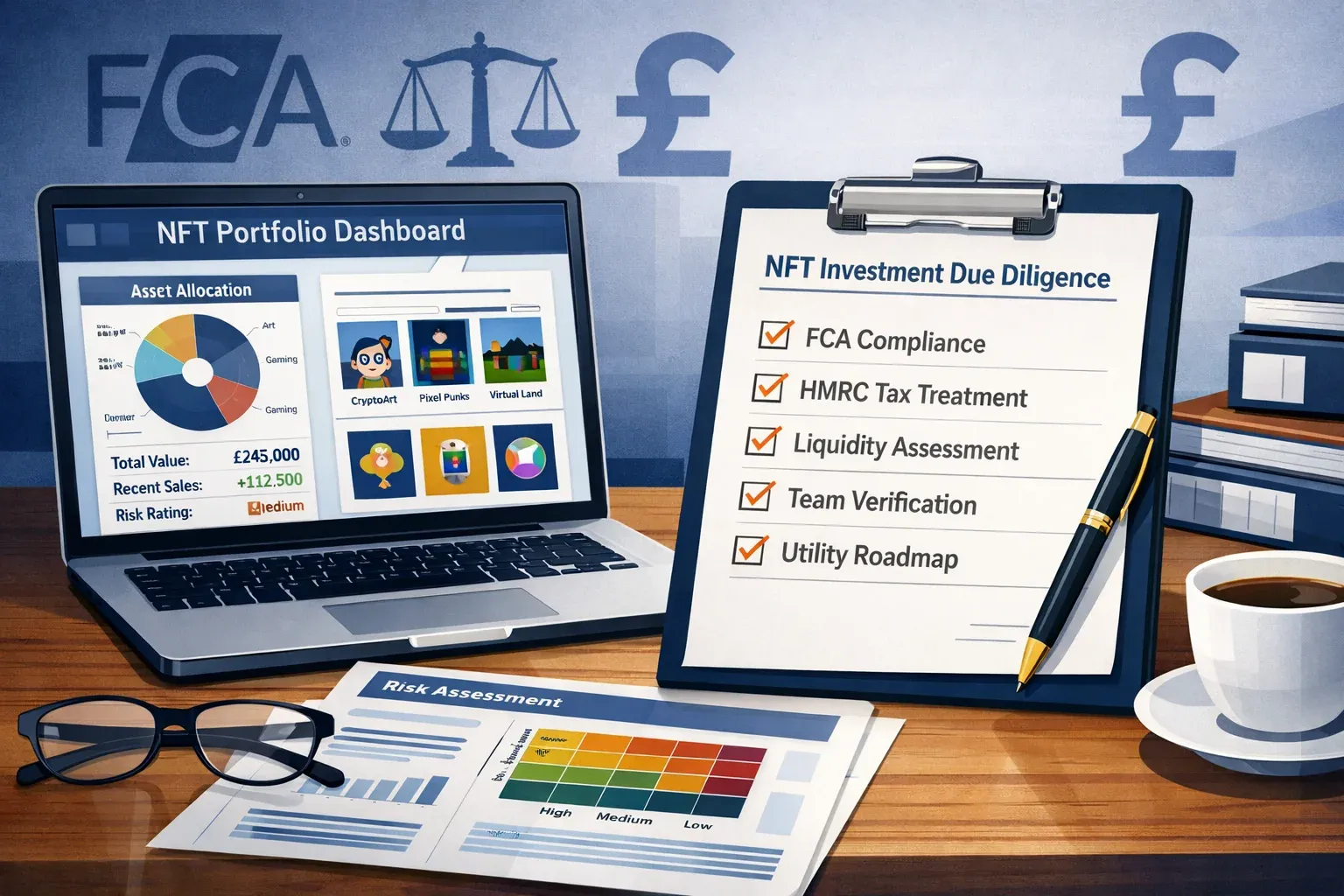
Before committing capital to any NFT investment, evaluate across these five dimensions:
1. Utility Assessment 🔍
- What does this NFT actually *do beyond existing?
- Is the utility dependent on a single platform or company?
- Can the utility function without the NFT (i.e., is blockchain necessary)?
2. Team and Execution Capability 👥
- Are team members publicly identified with verified credentials?
- What is their track record in delivering products?
- Is there a realistic roadmap with measurable milestones?
3. Liquidity and Market Structure 📈
- What is the average daily trading volume?
- How concentrated is ownership (whale analysis)?
- Which platforms support trading, and what are the fees?
4. Regulatory and Tax Position 🇬🇧
- How would HMRC classify this asset for Capital Gains Tax purposes?
- Does the project comply with UK Financial Promotion Rules?
- Are there any securities law implications?
5. Community and Network Effects 🌐
- What is the active (not total) community size?
- Are holders engaged or merely holding speculatively?
- Is there organic growth or primarily paid/incentivised participation?
Blue-Chip NFT Performance: A Reality Check
Even the most established collections tell a story of dramatic correction followed by selective recovery:
*Source: [1]
These figures underscore a critical point: blue-chip collections have stabilised near institutional floor prices, but speculative volume has dried up [1]. If you're considering established collections, treat them as illiquid venture bets,allocate only capital you can afford to lose and hold for years, not weeks [1].
> 💡 Professional Insight: The BAYC recovery to ~18 ETH was driven by brand integrations and IP licensing [1], not speculative demand. This is a meaningful distinction,value creation through commercial utility rather than greater-fool dynamics.
UK-Specific Considerations for NFT Investors
As the UK's independent standards body for crypto advisory professionals, we must emphasise the regulatory and tax landscape that UK-based investors face.
HMRC Tax Treatment
HMRC treats NFTs as cryptoassets for tax purposes. Key implications include:
- Capital Gains Tax applies when you dispose of an NFT (sell, swap, or gift)
- The annual CGT allowance (currently £3,000 for 2025/26) applies
- Income Tax may apply if you're creating and selling NFTs as a trade
- Record-keeping is your responsibility,maintain detailed transaction logs
FCA Regulatory Position
The FCA does not currently regulate NFTs directly, but:
- NFTs that function as securities or financial instruments may fall under FCA regulation
- Financial promotions relating to cryptoassets (including NFTs) are subject to the Financial Promotion Rules
- Advisers discussing NFTs with clients must ensure they provide appropriate risk disclosures
> ⚠️ For Advisers: If you're recommending NFT investments to clients, ensure your advice is FCA-compliant and that you maintain professional conduct standards. TrustCrypto's TCCA certification pathway includes specific modules on digital asset advisory obligations.
Anti-Money Laundering
UK crypto businesses must register with the FCA for AML purposes. When using NFT platforms, verify that:
- The platform is registered or operates under an equivalent regime
- KYC (Know Your Customer) procedures are in place
- Transaction monitoring is adequate
Building a Cycle-Aware NFT Strategy
Understanding market cycles is fundamental to any investment approach, and NFTs are no exception. Here's how to think about NFT allocation within a broader portfolio context.
Position Sizing
Given the illiquidity and volatility of NFTs, we recommend:
- Maximum 1–5% of total portfolio allocated to NFTs
- No single NFT or collection exceeding 1% of total portfolio value
- Only capital you can afford to lose entirely
Diversification Across Utility Categories
Rather than concentrating in one NFT category, consider spreading exposure across:
- 🎮 Gaming assets (highest growth trajectory)
- 🎫 Ticketing/events (most practical near-term utility)
- 🏠 RWA-adjacent tokens (longest-term potential)
- 🎨 Established art collections (if you have genuine conviction)
Entry and Exit Planning
- Define your thesis before buying: What specific utility or catalyst justifies this investment?
- Set time horizons: Most NFT utility plays require 2–5 year holding periods
- Identify exit triggers: What would change your thesis? Project team departures, regulatory changes, or utility failure should all be pre-defined exit signals.
The Professional Development Imperative
The shift from speculative NFTs to utility-driven digital assets creates a significant opportunity for financial professionals. Clients increasingly hold NFTs or are considering them, and they need advisers who understand this space with genuine depth.
At TrustCrypto Institute, our assessment-led certification programmes,including the TCCA (TrustCrypto Certified Advisor) and TCCS (TrustCrypto Certified Specialist),equip professionals with the knowledge and rigorous assessment standards needed to advise on digital assets, including NFTs, with confidence and institutional credibility.
Raising the baseline for crypto advisory isn't just our mission,it's a market necessity. As NFTs evolve from speculative art to functional infrastructure, the professionals who can guide clients through this transition will be in extraordinary demand.
Conclusion: Substance Over Speculation
The NFT market in 2026 rewards patience, discipline, and genuine understanding. The days of buying a JPEG and hoping for a 10x return are behind us. What lies ahead is more interesting,and more complex.
Your actionable next steps:
- Educate yourself thoroughly before allocating any capital to NFTs. Understand the technology, the utility categories, and the risks.
- Apply the due diligence framework outlined above to any NFT investment you're considering. If a project can't satisfy all five dimensions, move on.
- Understand your UK tax obligations. Consult HMRC's cryptoasset guidance and consider working with a tax professional experienced in digital assets.
- If you're a financial professional, invest in your own professional development. The crypto advisory space needs qualified professionals with verified credentials, not self-proclaimed experts.
- Adopt a long-term perspective. The most valuable NFT investments in 2026 will likely be those that solve real problems,not those that generate the most social media buzz.
The NFT market isn't dead. It's growing up. And for those willing to approach it with the same rigour they'd apply to any other asset class, the opportunities,beyond digital art,are genuinely compelling.
Credibility over hype. Always.
Related Resources
Explore these helpful tools and guides:
Take the Next Step
Ready to advance your crypto expertise? Explore our professional certification programmes to enhance your credentials.
References
- [1] Nft Market 2026 Dead Or Just Different - https://earnpark.com/en/posts/nft-market-2026-dead-or-just-different/
- [5] Trends In Tokenization Reimagining Real World Assets - https://www.bdo.com/insights/industries/fintech/trends-in-tokenization-reimagining-real-world-assets
- [7] Nft Startup Dogami Winds Down After Total Investment Of 14 Million Dollars - https://www.trendingtopics.eu/nft-startup-dogami-winds-down-after-total-investment-of-14-million-dollars/
- [8] The Architects Blueprint For High Utility Nft Marketplace Development - https://northpennnow.com/news/2026/feb/10/the-architects-blueprint-for-high-utility-nft-marketplace-development/