

Web3 is no longer a whitepaper promise. In 2026, the conversation has shifted decisively from "what could blockchain do?" to "what is blockchain actually doing?",and the answers are more substantive than many sceptics expected. With over 3,200 startups and 17,000 companies actively building in the Web3 space, supported by more than 2,300 investors and nearly 9,800 successful funding rounds [1], we are witnessing an ecosystem that has matured well beyond speculative token launches. Real-world Web3 use cases in 2026 span finance, healthcare, supply chains, creator economies, and enterprise operations,touching the lives of millions of users who may not even realise they are interacting with decentralised technology. Explore more in our Web3 section.
At TrustCrypto Institute, we approach this landscape as educators first. Our role is not to promote Web3 uncritically, but to help professionals,whether aspiring crypto advisors, compliance officers, or serious investors,understand where genuine utility exists, where challenges persist, and where professional standards must guide adoption. Learn more with our crypto tax calculator. Substance over speculation remains our north star.
This article examines the most significant real-world Web3 use cases in 2026, the barriers that still need addressing, and what this means for professionals navigating this rapidly evolving space.
Decentralised Finance: From Experiment to Infrastructure
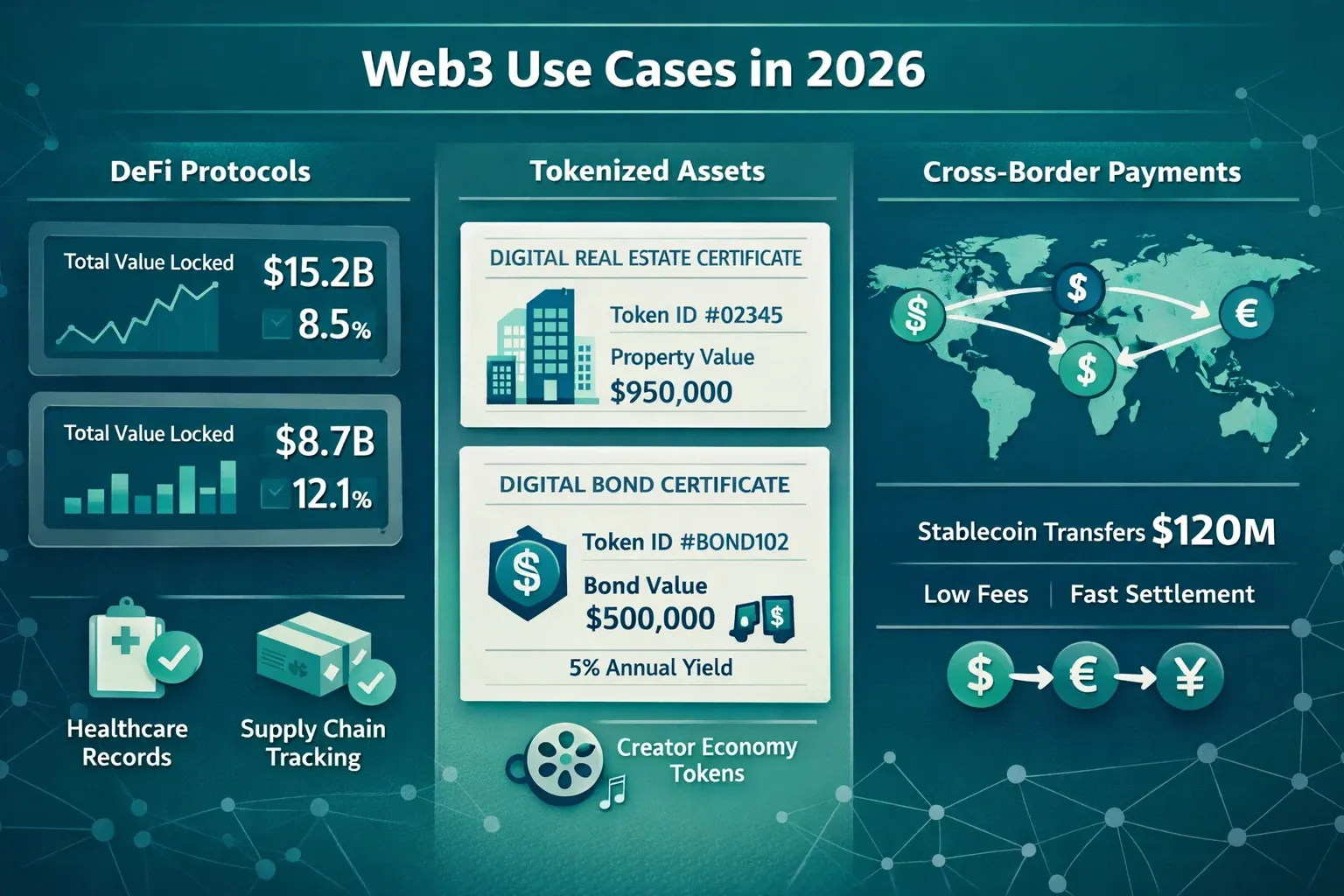
Perhaps no Web3 sector has matured more visibly than decentralised finance (DeFi). What began as experimental lending protocols and yield farming has evolved into operational financial infrastructure. DeFi protocols now handle billions in total value locked, with millions of users conducting real financial transactions daily [1].
For UK-based financial professionals, this shift demands attention. DeFi platforms are offering services that parallel,and in some cases improve upon,traditional financial products:
This is not to suggest DeFi has replaced traditional finance,it hasn't, and making such a claim would be irresponsible. But it has established itself as a complementary layer that qualified professionals must understand.
Stablecoins as Payment Rails
One of the most compelling real-world Web3 use cases in 2026 is the transformation of stablecoins from trading instruments into practical payment infrastructure. This year has seen expanded use of stablecoins for payouts, procurement, cross-border payroll, and even emergency cash distribution in volatile economies [4].
For UK firms with international operations, stablecoin-based payroll can reduce settlement times from days to minutes and cut transaction costs significantly. However,and this is where professional standards matter,firms must ensure compliance with FCA guidance on cryptoasset financial promotions and anti-money laundering requirements.
> Professional note: Any advisor recommending stablecoin strategies to clients must ensure transparent disclosures about counterparty risk, reserve backing, and regulatory status. This is precisely the kind of nuanced guidance that assessment-led certification prepares professionals to deliver.
Asset Tokenisation: Unlocking Illiquid Markets
Asset tokenisation,the process of representing ownership of real-world assets as blockchain-based tokens,is successfully creating new markets and enhancing liquidity across diverse asset classes [1]. In 2026, we are seeing tokenised:
- 🏢 Commercial property , fractional ownership starting from as little as £100
- 📜 Government and corporate bonds , with near-instant settlement
- 🎨 Fine art and collectibles , enabling broader investor access
- 🌾 Agricultural commodities , improving supply chain financing
The World Economic Forum has identified digital assets as reaching an inflection point, with tokenisation playing a central role in reshaping how value is created, transferred, and stored [5].
For compliance and risk professionals, tokenisation introduces novel considerations around custody, valuation methodology, and investor suitability. These are areas where clear frameworks and rigorous assessment become non-negotiable.
Enterprise Adoption: Web3 Beyond Crypto Speculation
Enterprise adoption of Web3 technology now spans multiple sectors, including finance, healthcare, supply chain management, and entertainment. Companies are deploying decentralised applications and smart contracts for digital asset management, identity verification, and transactional data integrity [1].
This is significant because it demonstrates that Web3's value proposition extends far beyond cryptocurrency trading. Let us examine the most impactful enterprise applications.
Supply Chain Transparency and Provenance
Supply chain management has emerged as one of the most practical and least controversial Web3 use cases. Blockchain-based tracking systems provide immutable records of product journeys from origin to consumer, addressing concerns around:
- Counterfeit goods (particularly in pharmaceuticals and luxury goods)
- Ethical sourcing verification
- Regulatory compliance documentation
- Recall management and liability tracking
For UK businesses subject to the Modern Slavery Act and ESG reporting requirements, blockchain-based supply chain verification offers a structured methodology for demonstrating compliance with evidence rather than assertions.
Healthcare: Patient Data Sovereignty
Healthcare represents a sector where Web3's core principles,data ownership, interoperability, and verifiable credentials,align naturally with pressing industry needs. In 2026, pilot programmes and early-stage deployments are using blockchain to:
- Give patients control over their medical records
- Enable secure, consent-based data sharing between providers
- Create tamper-proof audit trails for clinical trials
- Verify healthcare professional credentials
The parallels with our own work at TrustCrypto Institute are striking. Just as we use public verification to confirm advisor credentials, healthcare systems are exploring blockchain-based credential verification to ensure that professionals are who they claim to be.
Decentralised Social Media and the Creator Economy
Web3 is reshaping creator economics in ways that deserve serious professional attention. Decentralised social media platforms now allow users to earn tokens for generating quality content and maintain data ownership across multiple platforms without platform lock-in [2].
This shift has implications for:
- Content creators who can monetise directly without intermediary fees of 30-50%
- Investors evaluating creator economy platforms as investment opportunities
- Compliance professionals navigating the regulatory treatment of creator tokens
NFTs and tokenisation have introduced new ownership models for digital content, enabling direct monetisation and user empowerment beyond traditional intermediaries [1]. However, the regulatory landscape for creator tokens remains complex, and professionals advising in this space need a compliance-first approach grounded in current FCA guidance.
AI and Blockchain Convergence
A defining trend of 2026 is the integration of artificial intelligence with blockchain technology, powering smarter and more efficient decentralised applications [1]. This convergence is producing:
- 🤖 AI-powered smart contract auditing , reducing vulnerability risks
- 📊 Predictive analytics for DeFi protocols , improving risk management
- 🔍 Automated compliance monitoring , helping firms meet regulatory obligations
- 🧠 Intelligent portfolio rebalancing , for tokenised asset portfolios
Space and Time, for example, has demonstrated real-world use cases combining verifiable data infrastructure with blockchain to enable trustworthy, on-chain computation [6]. For professionals, this convergence underscores the importance of continuing education and CPD requirements,the technology is evolving rapidly, and yesterday's knowledge is insufficient for tomorrow's advisory needs.
Persistent Barriers: An Evidence-Based Assessment
At TrustCrypto Institute, we believe that credibility demands honesty about limitations. Despite genuine progress, several significant barriers continue to constrain Web3 adoption in 2026.
Scalability Constraints
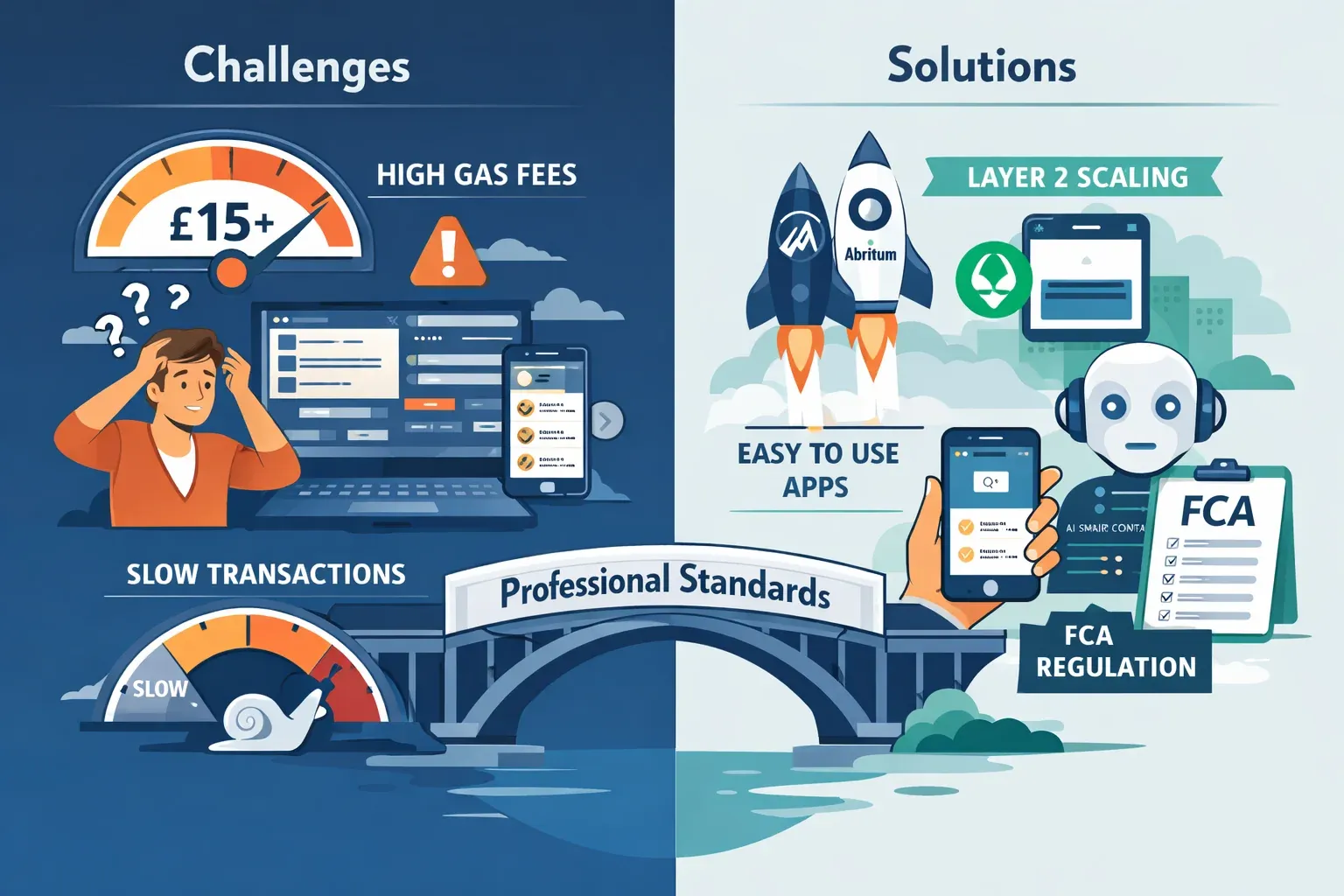
Current blockchain networks still process fewer than 100 transactions per second,a significant gap compared to Visa's capacity of tens of thousands [1]. While layer-2 solutions like Arbitrum and zk-Rollups are making meaningful progress, the scalability challenge remains real:
Progress is evident, but the gap remains substantial for mass-market consumer applications.
Gas Fees and Cost Barriers
Gas fees on Ethereum can still exceed £16 per transaction during peak demand [1], making many micro-transactions economically unviable. This disproportionately affects:
- Small retail investors
- High-frequency DeFi interactions
- Developing market users
Layer-2 solutions reduce these costs dramatically, but they introduce their own complexity around bridging assets between layers,which brings us to the next barrier.
User Experience Complexity
Wallet management, private keys, and asset bridging continue to intimidate even tech-savvy users [1]. The industry has made progress through improved user interfaces and mobile applications [1], but the gap between Web3 and traditional fintech user experience remains significant.
> 💡 Key insight for advisors: The complexity of Web3 user experience is precisely why qualified professionals are needed. Clients navigating this space benefit enormously from advisors with verified credentials who can guide them through technical and regulatory complexity with a long-term perspective.
Regulatory Uncertainty
While the UK has made progress with its cryptoasset regulatory framework,including the FCA's Financial Promotion Rules for cryptoassets,the regulatory landscape remains fragmented globally. Professionals operating in this space must adopt a compliance-first mindset, staying current with evolving guidance from the FCA, HMRC, and HM Treasury.
What This Means for Professionals: A Call for Standards
The maturation of real-world Web3 use cases in 2026 creates both opportunity and obligation for professionals across the financial services ecosystem.
For Aspiring Crypto Advisors
The breadth of Web3 applications,from DeFi to tokenised assets to supply chain solutions,means that generalist knowledge is no longer sufficient. Clients expect advisors who understand:
- The technical fundamentals of blockchain infrastructure
- The regulatory requirements specific to different Web3 applications
- The risk profiles of various decentralised protocols
- Tax implications under HMRC guidance for tokenised assets
This is where assessment-led certification and certification pathways become essential. A structured methodology for building and verifying expertise ensures that professionals can deliver advice that meets the highest standards of competence and ethics.
For Compliance and Risk Professionals
Every real-world Web3 use case discussed in this article introduces compliance considerations that traditional frameworks were not designed to address. From DeFi lending protocols to tokenised securities to AI-blockchain convergence, published frameworks and rigorous assessment are needed to ensure that innovation does not outpace accountability.
For Serious Investors
With over £50,000 or more allocated to crypto and digital assets, serious investors need advisors who can distinguish genuine utility from marketing narratives. The evidence presented here suggests that Web3 has moved meaningfully beyond hype in specific sectors,but that risk disclosure and cycle-aware strategy remain essential.
Conclusion: Credibility Over Hype
Real-world Web3 use cases in 2026 demonstrate that decentralised technology has crossed a meaningful threshold. DeFi is processing real financial transactions at scale. Stablecoins are functioning as payment infrastructure. Tokenisation is unlocking previously inaccessible markets. Enterprise adoption spans healthcare, supply chains, and the creator economy.
Yet significant challenges persist. Scalability, cost, user experience, and regulatory clarity all require continued progress. The gap between Web3's current capabilities and mainstream financial infrastructure remains real.
For professionals, the message is clear: standards matter. The opportunities created by Web3's maturation demand qualified professionals who can navigate complexity with integrity. At TrustCrypto Institute, we exist to raise the baseline for crypto knowledge and professional conduct through clear frameworks, rigorous assessment, and transparent standards.
Your Next Steps
- Assess your knowledge gaps , Where do real-world Web3 applications intersect with your professional responsibilities?
- Invest in professional development , Explore certification pathways that provide structured, evidence-based education rather than hype-driven content.
- Stay current with UK regulation , Monitor FCA guidance, HMRC updates, and HM Treasury consultations on cryptoassets and digital securities.
- Demand credentials from advisors , Whether you are an investor or a firm, insist on verified credentials and public verification of professional competence.
- Think long-term , Web3's real value lies in infrastructure, not speculation. Adopt a long-term perspective grounded in professional accountability.
The future of Web3 is being built by professionals who prioritise trust and consistency over short-term excitement. We encourage you to be among them.
Related Resources
Explore these helpful tools and guides:
Take the Next Step
Ready to advance your crypto expertise? Explore our professional certification programmes to enhance your credentials.
References
- [1] Is Web3 Just A Buzzword Or Is It Real Separating Hype From Reality In 2026 - https://blog.tokenmetrics.com/p/is-web3-just-a-buzzword-or-is-it-real-separating-hype-from-reality-in-2026
- [2] What Is Web3 In Real Life Example - https://web3.career/learn-web3/what-is-web3-in-real-life-example
- [3] Web3 Beyond Crypto Real World Enterprise Use Cases - https://www.konceptconference.com/blogs/web3-beyond-crypto-real-world-enterprise-use-cases
- [4] 10 Web3 And Crypto For Good Trends To Watch In 2026 - https://www.cryptoaltruists.com/blog/10-web3-and-crypto-for-good-trends-to-watch-in-2026
- [5] Digital Economy Inflection Point What To Expect For Digital Assets In 2026 - https://www.weforum.org/stories/2026/01/digital-economy-inflection-point-what-to-expect-for-digital-assets-in-2026/
- [6] 4 Real World Use Cases Enabled By Space And Time And Instruxi - https://spaceandtime.io/blog/4-real-world-use-cases-enabled-by-space-and-time-and-instruxi